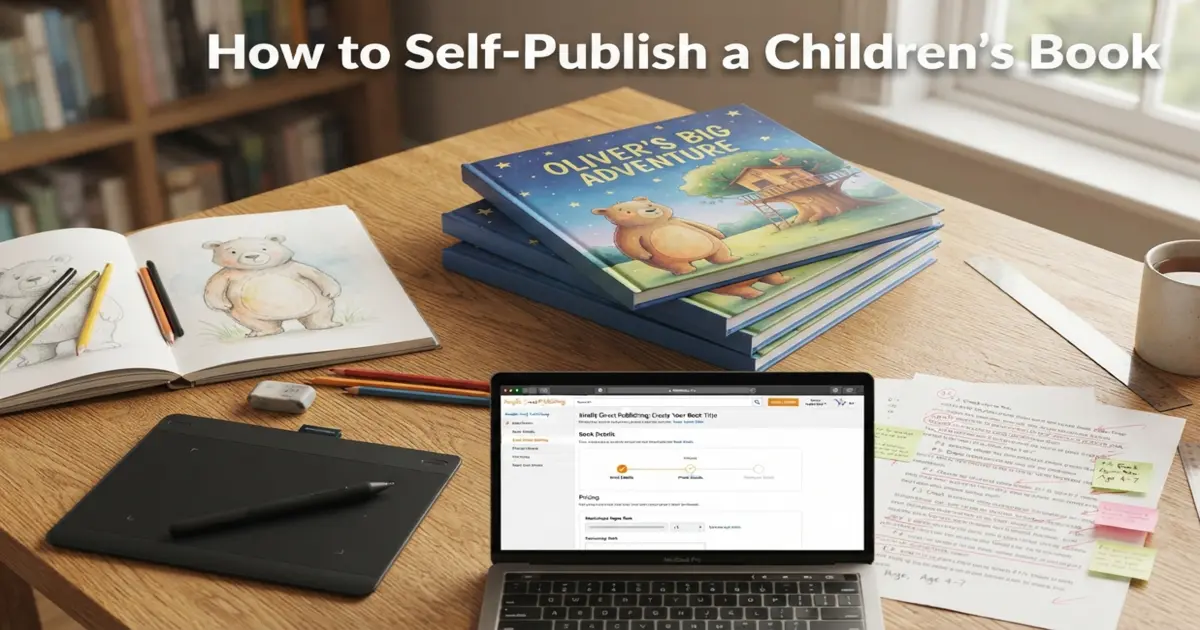
So you’ve got a story. Maybe it’s been sitting in a notes app for two years, or maybe you wrote it last weekend for your daughter and now three people have told you it should be a real book. Either way, you’ve probably typed some version of “how to self publish a childrens book” into Google at 11pm and gotten a hundred different answers, half of them contradicting each other.
Here’s the short version before we get into the long one: you don’t need a publisher, an agent, or a trust fund. You need a finished manuscript, someone who can illustrate it properly, a file that meets print specs, and a KDP account. That’s genuinely most of it. The rest is just doing those four things well instead of rushing them.
Why People Are Skipping Traditional Publishers Entirely
A friend of mine spent almost two years querying agents for a 600-word picture book. Two years. For six hundred words. That’s not unusual — traditional publishing timelines for children’s books routinely stretch past 24 months once you factor in the querying stage, and that’s assuming someone says yes at all.
Self-publishing skips that line completely. You write it, you get it illustrated, you upload it, and it’s live within days. You also keep the rights and most of the money, which matters more than people expect once a book starts selling. The catch is obvious: nobody’s doing the editing or the art for you anymore. That part’s on you now, or on whoever you hire.
Start With the Manuscript, Not the Pictures
I know it’s tempting to jump straight to what the book looks like — that’s the fun part. But get the words locked first. Figure out your age range early because it changes everything downstream. A board book for a two-year-old might be 12 pages and barely 100 words. A picture book for a five- or six-year-old usually lands around 32 pages, sometimes 40, following the printer’s standard page counts. Early readers for seven-to-nine-year-olds carry a lot more text and lean less on full illustrated spreads.
Get an actual editor to look at it. Not your sister, no offense to sisters. In a manuscript this short, a single flat line or a rhyme that doesn’t quite land sticks out way more than it would in a novel, and readers — or their parents, really — notice immediately.
What Self-Publishing a Children’s Book Actually Costs
This is where most people either get scared off or get scammed, and honestly both happen a lot. Numbers online range from “$300 total” to “$10,000,” and neither is telling you the whole picture. Here’s roughly what it breaks down to for a standard 32-page picture book:
Editing usually runs $150 to $800 depending on how experienced the editor is and how much work the manuscript needs. Illustration is the big one — anywhere from $800 on the low end up to $5,000 or more if you want detailed, painterly art across every spread. Cover design, if it’s handled separately from the interior, adds another $150 to $600. Formatting the interior file properly costs $50 to $300, or nothing if you’re comfortable doing it yourself in the right software. KDP gives you a free ISBN, though buying your own from Bowker runs about $125. And don’t skip ordering a physical proof before launch — that’s another $20 to $50 in printing and shipping, and it’s money well spent because catching a formatting error on screen is a lot harder than catching it in your hands.
Add it up and a solid, professionally produced picture book usually lands somewhere between $1,500 and $4,000. If someone offers to illustrate a full 32-page book for $200, ask to see samples of a complete project, not just a single character sketch. There’s a difference between someone who can draw and someone who understands how to pace a story across facing pages.
Getting the Illustrations Right
Kids judge books by their covers more honestly than adults do, and parents aren’t far behind. If the art looks off, nothing else in the book gets a chance. So how to illustrate a children’s book without blowing your budget or your timeline? There are basically three paths.
You illustrate it yourself, which works great if you actually have the skill for it — just be honest about whether your art is publish-ready or still developing. You hire a freelancer through a marketplace, which is often cheaper but means you’re managing revisions, licensing terms, and file specs on your own, and quality swings wildly from one artist to the next. Or you work with a studio built around children’s book illustrations services specifically, where character consistency and print-ready files come as part of the process instead of something you have to chase down afterward.
That third option tends to be worth the money more often than people assume, mostly because redoing an entire illustrated book after discovering the files weren’t set up for print is expensive in a way that’s hard to undo. Drawphics builds its children’s book illustration services around exactly this — keeping characters looking like themselves from page 3 to page 30, and delivering files at the resolution and bleed settings KDP actually wants, rather than something you find out is wrong after upload.
One thing worth locking down before illustration starts: your character designs. Changing how a character looks halfway through a 32-page manuscript means redrawing pages everyone thought were done. It happens more than you’d think.
Formatting and Design, or Why Your File Keeps Getting Rejected
Children’s book formatting and design is the unglamorous part nobody warns you about, and it’s also where good books quietly stall out. Amazon KDP and IngramSpark reject far more files for bleed errors, wrong trim size, and low-resolution art than for anything to do with the story itself.
A few things that genuinely matter: set your file up at the exact trim size you’re planning to sell, with 8.5″ x 8.5″ and 8″ x 10″ being the most common for picture books. Any artwork touching the page edge needs a 0.125″ bleed. Keep text at least half an inch from the trim line so nothing gets clipped during binding. Export interior images at 300 DPI — anything lower and it looks soft or pixelated once it’s actually printed. And make sure your cover’s spine width matches your final page count using KDP’s built-in calculator, because getting that wrong is a surprisingly common last-minute headache.
If this list already sounds like a lot, that’s honestly the point of mentioning it — this is exactly where DIY authors submit a great story wrapped in a technically broken file. We go deeper into print prep in our guide to formatting children’s activity books, and most of it applies to picture books too.
Print on Demand vs. Ordering Bulk Copies
For nearly everyone starting out, print on demand children’s books is the smarter move. Copies only print once someone actually buys one, so there’s no warehouse full of unsold inventory sitting in your garage or a storage unit.
Amazon KDP and IngramSpark are the two big names here. KDP gets you onto Amazon the fastest and the setup is genuinely simple. IngramSpark reaches further — bookstores, libraries, other retailers — but it comes with setup fees and lower royalties on anything sold through Amazon specifically. A lot of authors end up using both once a book proves it can sell: KDP for Amazon, IngramSpark for everywhere else.
Bulk offset printing only starts making sense once you know there’s real demand — school visits lined up, a following that’s already asking, preorders that justify ordering 250 or more copies at a lower cost per unit.
Amazon KDP Children’s Book Publishing, Step by Step
Amazon KDP children’s book publishing costs nothing to set up, and it’s still the most common launch path for authors in the US. Here’s roughly how it goes:
Create a free account at kdp.amazon.com. Pick paperback or hardcover — KDP now offers both — and fill in your title, series details, and description. Choose your trim size and upload the interior PDF along with your cover file. Run everything through KDP’s free online previewer before you approve anything, checking every spread for bleed issues, cropping, and color shifts. Set a price, typically somewhere between $9.99 and $16.99 for picture books sold in the US, and choose your royalty option. Pick your categories and keywords with actual care, because this is what decides whether a parent searching Amazon ever finds your book at all. Then hit publish, and it usually goes live within about 72 hours.
The cover carries a lot of weight here since it’s the only thing a shopper sees before they click. If your interior illustrator isn’t also strong on cover composition and type, it’s worth splitting that out to someone who focuses on book cover design — we broke down what’s actually working right now for the US market in our book cover design trends guide.
The Full Step by Step Children’s Book Publishing Checklist
Pulling all of this into one step by step children’s book publishing checklist:
- Finish and get your manuscript professionally edited
- Decide on age group, page count, and trim size
- Lock your character designs before full illustration begins
- Get the interior fully illustrated
- Format the interior file to exact print specs
- Design a cover that actually reads well as a thumbnail
- Order a physical proof and check it in your hands
- Set up KDP and upload your files
- Choose pricing, categories, and keywords deliberately
- Plan your launch — reviews, social posts, local bookstores, a school visit if you can swing one
Getting People to Actually Read It
Publishing the book is the finish line for production, not for sales. Ask people you trust for honest reviews once it’s live, because reviews are one of the strongest signals Amazon uses to decide what to show people. Talk to a local bookstore about carrying it on consignment. See if your kid’s school or the local library would host a reading. Post the art on social media as you go — behind-the-scenes sketches, character reveals, that sort of thing. Children’s books sell through word of mouth among parents more than almost any other category, so don’t underestimate a good group text.
Mistakes That Keep Showing Up
Skipping professional editing because the manuscript is short and “how hard can 500 words be.” Choosing an illustrator on price alone without asking to see a full, consistent sample project. Uploading a cover that looks fine at full size on a laptop but turns to mush as a thumbnail on someone’s phone. Ignoring KDP’s category and keyword settings, so the book is technically published but functionally invisible. And pricing it too low, which — counterintuitively — can make buyers assume it’s low quality instead of a bargain.
If any part of this feels like more than you want to take on solo, we’ve walked plenty of authors through this exact process, from first character sketch to final KDP upload. Take a look at our portfolio, or just reach out and tell us where you’re at.
Frequently Asked Questions
How long does it take to self-publish a children’s book?
Most authors finish in 3–6 months, counting editing, illustration, and formatting before the KDP upload happens.
Do I need an ISBN to self-publish on Amazon?
No, KDP gives you a free one. Buying your own lets you publish under your own imprint name instead.
Can I illustrate my own children’s book without formal training?
Yes, if the art is genuinely print-ready and consistent. Many authors still choose to hire an illustrator for polish.
How much does a 32-page picture book typically cost to produce?
Usually $1,500 to $4,000 all-in, with illustration almost always the single largest expense in that total.
Is Amazon KDP actually free to use?
Yes. There’s no setup fee — Amazon makes money through printing costs and a share of each book’s royalty.
Last Thing
Learning how to self-publish a children’s book really just comes down to treating it like a small production project instead of a mystery. Solid manuscript, illustrations that hold up page after page, a file that meets print specs, and a launch plan that doesn’t stop the moment the book goes live. None of it requires a publishing deal — it just requires getting the right pieces done at the right time. If illustration or cover work is the part holding you back, our KDP children’s book team can take that off your plate and get your story print-ready without you having to guess your way through it.