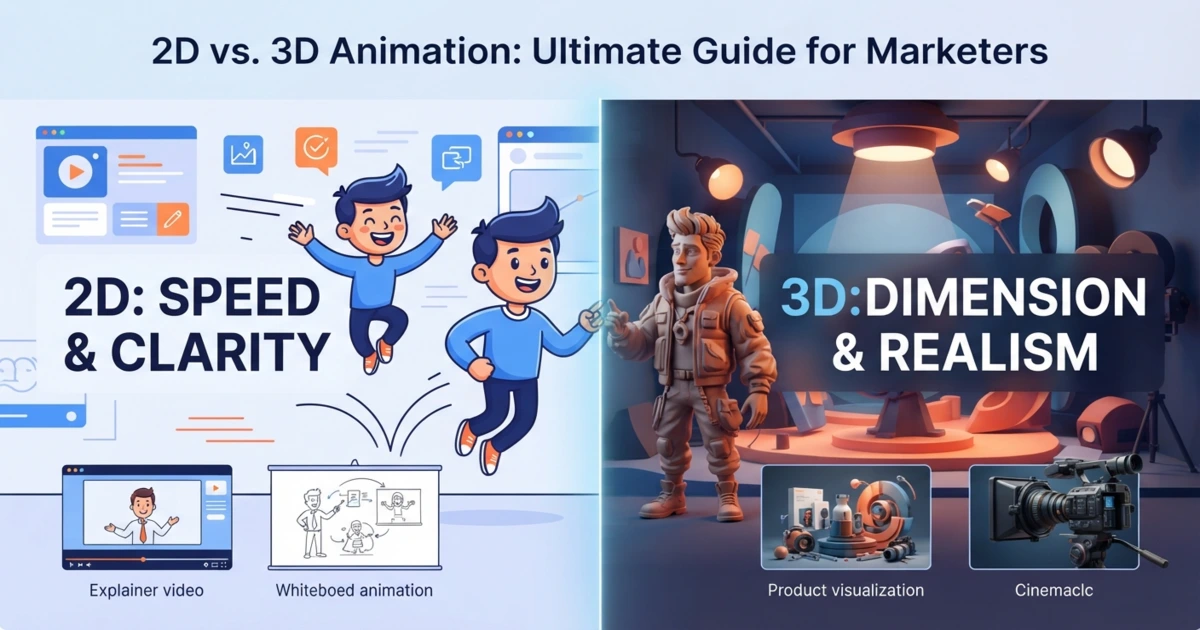
Somebody on your team is probably going to bring up 2D vs 3D animation marketing at your next planning meeting, and honestly, it’s a fair question to raise. Half the brands we talk to default to 3D because it “looks more expensive,” and the other half stick with 2D out of habit. Neither reason holds up once you actually sit down and think about what the video is supposed to do.
There isn’t a single right answer here. A dentist’s office explaining a new procedure has completely different needs than a headphone brand launching a flagship product. This 2D vs 3D animation guide is meant to save you from picking a format based on gut feeling or what a competitor did last year — and instead pick based on what actually moves your audience.
What 2D Animation Actually Looks Like in Marketing
2D animation is flat — literally. It moves on two axes, no camera depth, no lighting simulation. Think whiteboard videos, animated explainer content, a mascot character bouncing across a landing page banner, or motion graphics stacked over on-screen text.
For animated video for business marketing, 2D still does most of the heavy lifting across the industry, and there’s a reason for that. It’s quick to produce, it’s forgiving during revisions, and it can explain something complicated — a workflow, an app feature, a service model — without confusing anyone in the first ten seconds.
We build a lot of this exact style through our 2D & 3D Animation services, and it’s usually the first thing we recommend to a newer brand that needs something on their site or ad account fast, without burning through their whole quarterly budget.
Where 2D Pulls Its Weight
- Explainer videos for apps, platforms, and B2B software
- Fast-paced social ads meant to stop a thumb mid-scroll
- Step-by-step onboarding content
- Recurring brand mascots that show up across campaigns
- Whiteboard-style breakdowns aimed at technical or corporate audiences
If any of that sounds like your next brief, take a look at our whiteboard animation and explainer video work — it’s built specifically around this kind of fast, clear storytelling.
What 3D Animation Actually Looks Like in Marketing
3D is a different beast entirely. You’re building an actual dimensional space — objects with weight, materials that reflect light, cameras that swoop and rotate around a subject like you’re on a film set. It’s the format behind those product reveal videos that make a $40 water bottle look like it belongs in a museum.
For companies selling anything physical, 3D product animation services tend to earn their cost back fast. A rotating 3D render of a sneaker, a cutaway of how a coffee machine works internally, an exploded-view of industrial equipment — none of that translates well in flat 2D. You need the depth.
Where 3D Pulls Its Weight
- Product launches and hero shots for e-commerce
- Automotive, hardware, and industrial marketing
- Real estate and architectural walkthroughs
- Packaging reveals and unboxing-style promo content
- Premium, cinematic brand films
2D vs 3D Animation for Business: A Side-by-Side Look
Here’s the fastest way to compare marketing video animation styles before you commit a budget line to either one.
| Factor | 2D Animation | 3D Animation |
| Turnaround time | Faster, fewer production stages | Slower — modeling and rendering take time |
| Typical cost | Lower to mid-range | Mid to premium |
| Best suited for | Explaining ideas, apps, and services | Showing off a physical product |
| Visual feel | Flat, stylized, approachable | Dimensional, textured, realistic |
| Revision flexibility | Easy and cheap to adjust | Costlier to change mid-production |
| Where it performs | Social ads, explainers, mascots | Product pages, launches, commercials |
That table answers most of the when to use 2D or 3D animation question on its own, but a chart only gets you so far. The real decision comes down to your product and your goals.
When to Use 2D or 3D Animation: Ask Yourself This
Skip the guesswork. Run your project through these four questions instead.
Are you selling an idea, or an object you can hold? Software, services, and concepts lean 2D. Anything with texture, shape, or moving parts leans 3D.
How much runway do you have? 2D moves from script to finished video noticeably faster. If your launch date is three weeks out, 2D is the safer bet.
What’s the actual budget? The cost of 2D vs 3D animation for brands isn’t set in stone, but 3D almost always costs more — modeling, texturing, lighting, and rendering are separate skill sets, and each one adds hours. If money’s tight this quarter, start with 2D and put 3D on the roadmap once the campaign proves itself.
Where is this video going to live? Instagram Reels and TikTok reward bold, instant-read 2D motion. Product detail pages and YouTube pre-roll reward the immersive pull 3D gives you.
Cost of 2D vs 3D Animation for Brands
Pricing varies by agency, obviously, but the general pattern across the US market holds pretty steady: 2D costs less because it involves fewer technical stages between script and final export. 3D adds cost at nearly every step — a model has to be built, textured, rigged if it moves, lit properly, and rendered, and rendering alone can take hours per shot on a complex scene.
That doesn’t mean cheaper always wins. A rushed 3D render can honestly look worse than a well-made 2D piece, and a flat, uninspired 2D explainer can undersell a genuinely great product. Price shouldn’t be the only factor — match the format to the message first, then find a studio that can actually deliver it well. That’s part of why brands often hire 2D animation agency partners who also handle 3D in-house, so the visual style stays consistent instead of switching vendors mid-campaign.
Building an Animated Video Marketing Strategy That Uses Both
You don’t have to pick a lane and stay in it forever. A solid animated video marketing strategy usually blends both formats depending on where a prospect is in the funnel:
- Top of funnel — 2D motion graphics or a mascot character for scroll-stopping social ads
- Middle of funnel — a 2D explainer that walks someone through what your product actually does
- Bottom of funnel — 3D product animation right before checkout, when someone needs to see the real thing up close
This kind of layered approach keeps your production costs reasonable while still giving each stage the visual weight it needs. If a recurring character is part of that strategy, our character design and rigging of character work can build a mascot that follows your brand from ad to ad without looking repetitive.
Best Animation Style for Marketing Campaigns, by Industry
- SaaS and tech startups — 2D explainers, onboarding walkthroughs
- E-commerce and consumer goods — 3D product animation, packaging reveals
- Real estate and architecture — 3D walkthroughs
- Healthcare and finance — 2D motion graphics, mostly for clarity and trust
- Fashion and beauty — usually a mix, 2D for social storytelling and 3D for hero product shots
- Automotive and industrial — 3D, almost always, for the mechanical detail
Landing on the best animation style for brand campaigns really comes down to what your audience needs to understand — or feel — in the first five seconds of the video.
Mistakes We See Marketers Make With Animation
- Choosing 3D because it looks pricier, even when the product doesn’t need any depth at all
- Going 2D for a physical product launch and losing the tactile, premium feel buyers expect
- Making one video and forcing it onto every platform without adjusting the format
- Skipping the storyboard step, which almost always leads to expensive changes mid-production
- Working with a studio that only knows one style, so the recommendation you get is biased before the conversation even starts
Most of these get solved simply by working with a team offering custom animated marketing videos in both formats, so what you’re told to do is based on strategy — not on what the studio happens to be good at.
How Drawphics Helps You Pick the Right Format
At Drawphics, we don’t push every client toward the same style just because it’s easier for us. We start with your product, your audience, and your goals, then recommend 2D, 3D, or a mix of both depending on what the campaign actually calls for. You can browse real client work in our portfolio, read more about how we work on the About Us page, or contact us directly to talk through your next project.
Final Thoughts
2D vs 3D animation marketing was never really a competition to begin with — it’s a matching exercise. 2D wins on speed, cost, and clarity. 3D wins on realism and texture. The brands getting the best results right now aren’t choosing sides; they’re using each format where it naturally performs best.
If you’re still stuck on which way to go, start with two things: what you’re selling, and how much time you have. The right format usually reveals itself from there.
Frequently Asked Questions
1. Is 2D or 3D animation better for marketing?
Neither wins outright. 2D fits ideas, apps, and tight timelines. 3D fits physical products that need realism and depth.
2. How much more does 3D animation cost than 2D?
3D usually costs more because of modeling, texturing, and rendering. 2D is faster to produce and generally more affordable.
3. Can a single campaign use both 2D and 3D?
Yes — many brands run 2D for ads and explainers, then switch to 3D for product reveals within the same campaign funnel.
4. Which style works best for social media ads?
2D tends to perform better on fast-scroll platforms since it reads instantly without the extra visual weight of 3D.
5. How do I pick an animation agency for my brand?
Choose a studio offering both 2D and 3D, like Drawphics, so you get a format recommendation based on strategy, not specialty.