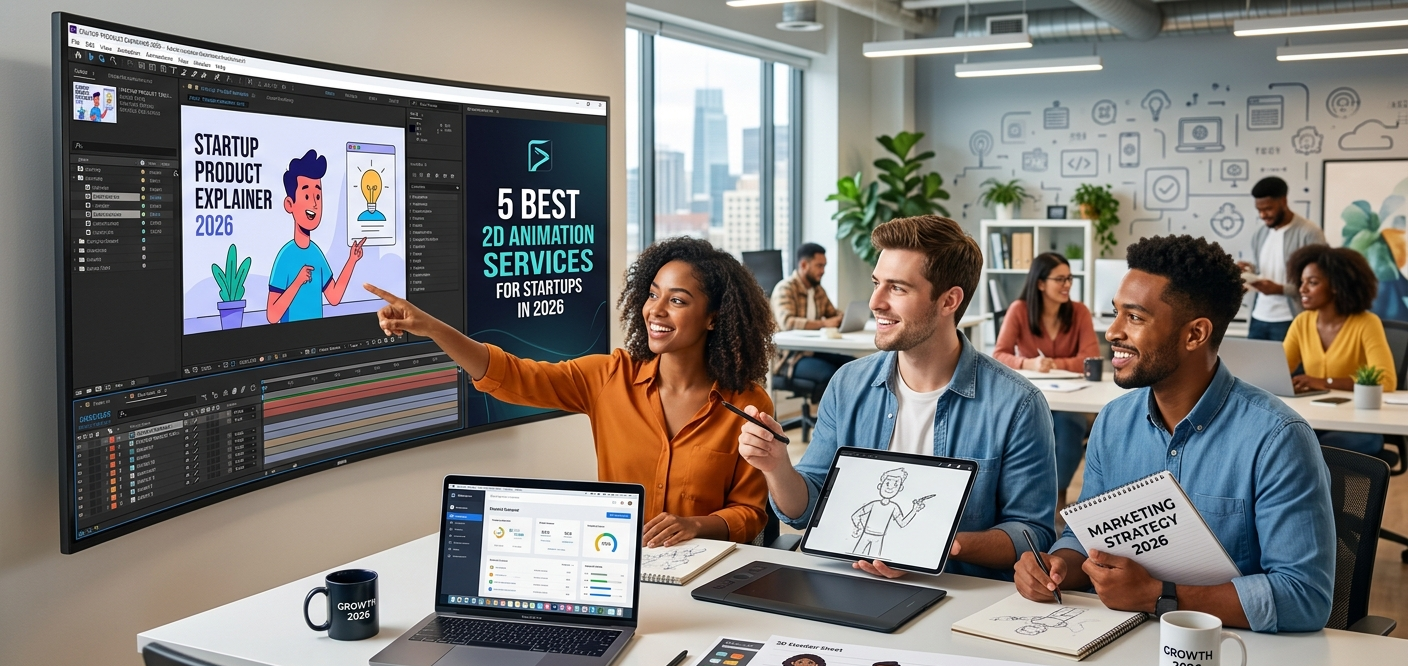
Nobody tells you this when you’re building a startup, but at some point you’re going to have a problem that has nothing to do with your product.
Your product works. Maybe it works really well. But when you try to explain it — to a customer, to an investor, to literally anyone who didn’t help you build it — you lose them somewhere around the third sentence. Their eyes do that thing. You know the thing.
That’s the moment most founders go looking for 2D animation services for startups. Not because animation is trendy. Because a 60-second animated video explains in one minute what a 1,200-word landing page fails to do in ten.
I’ve talked to enough startup teams to know the pattern. Someone watches a competitor’s explainer video and thinks, “we need one of those.” Then they Google around, get overwhelmed by pricing that ranges from $500 to $50,000 with zero explanation of why, and either overpay for something mediocre or underpay for something embarrassing.
This guide cuts through that. Below are the five best 2d animation service providers for startups in 2026 — what they’re actually good at, who they’re right for, and what you should know before you sign anything.
Why Startups Specifically Need 2D Animation
Here’s the thing about 2D animation for startups that makes it different from what a Fortune 500 company does with video: you don’t have brand equity to fall back on.
When a company like Slack runs a half-abstract brand video, people already have context. They know what Slack is. The video just reinforces a feeling. You don’t have that yet. Every video you make has to do three jobs at once — introduce who you are, explain what you do, and give someone a reason to take the next step. That’s a lot to ask of a 60-second clip.
2D explainer videos for startups are built around that constraint. The format forces you to strip your pitch down to its essential skeleton. One audience. One problem. One solution. One call to action. That discipline makes the video better. It also, frankly, makes your marketing strategy better.
Beyond the clarity benefit, there are a few practical reasons custom 2D animation dominates early-stage startup video:
It’s cheaper than live-action without looking cheap. No crew, no location, no reshoots. The money goes into craft, not logistics.
It ages well. When your product features change — and they will change — you update a few frames instead of booking a full production day. Characters don’t show up to the re-shoot with a different haircut.
It works everywhere. The same animated promotional video you put on your homepage can be cut for Instagram, dropped into a pitch deck, and used as a LinkedIn ad. That kind of reuse matters when your content team is one person with four other jobs.
And it builds visual identity from the ground up. The character style, color language, and motion design in your animation become part of how people recognize your brand. That consistency builds up quietly over time in ways that stock photography never could.
Take a look at what Drawphics covers across their animation services — the range from character-driven 2D work to explainers to whiteboard gives you a sense of how much flexibility the format actually has.
What to Actually Look at Before Hiring a 2D Animation Studio
Before I get to the list, let’s talk about the part most guides skip: how to evaluate 2d animation companies before you hand over a deposit.
Watch their reel with the sound off. Seriously. A lot of studios use music to paper over weak motion work. When you mute it, you see whether the animation itself has weight and timing — or whether it’s just slides fading in and out with a nice soundtrack.
Ask who writes the script. Some studios write it. Some hand you a template and expect you to fill it in. Some tell you they write it but actually give it to a junior staffer who’s never talked to your customer. The script is 70% of what makes a video land or miss. Know exactly who’s responsible for it.
Read the revision clause carefully. Not the one in the pitch deck. The one in the actual contract. I’ve seen startups burned by studios where every revision after round one triggers an hourly billing cycle. That adds up fast when you’re iterating on messaging.
Ask for a realistic timeline, not a best-case one. A 2d video animation service that tells you a 90-second video takes two weeks either has a large idle team waiting for your project or is going to deliver something templated. Four to six weeks for a properly made explainer is normal. Three is aggressive. Two should make you nervous.
Check how they handle communication. Small thing that turns into a big thing: do they give you a point of contact or do your emails go into a support ticket system? For a startup, being able to actually talk to the person making decisions about your video is worth paying for.
5 Best 2D Animation Services for Startups in 2026
1. Drawphics — Best Overall 2D Animation Service for Startups
If you’ve been searching for creative 2D animation services that don’t feel like they came off a production line, Drawphics is worth a serious look.
What makes them different from most animation studios for startups is that they’re built around illustration first, animation second. That order matters. Most explainer video factories start with a template — they have a library of characters and backgrounds, and they plug your script into the existing system. What comes out looks fine. It also looks exactly like twelve other startup videos you’ve seen this month.
Drawphics builds visual assets from scratch for each project. Their 2D & 3D animation work starts with character design and style development specific to your brand before a single frame gets animated. The result is something that actually looks like your company, not a generic SaaS brand with blue gradients and round-headed characters.
Their explainer video service is what most early-stage startups come for first. The team handles the full pipeline — scripting, storyboard, style frames, animation, voice-over coordination, sound design. You’re not project-managing five separate vendors. That matters when your bandwidth is already stretched.
There’s also a practical business reason to keep your creative work under one roof: the characters and visual language Drawphics builds for your animation can carry over into your pitch deck design, your website illustrations, and your social media graphics. When you explore their illustration services, you see how the same creative foundation extends across formats. That kind of visual consistency is genuinely hard to achieve when you’re working with disconnected freelancers for each deliverable.
For startups with a real brand story to tell — not just a product to demo — this is the studio I’d start with.
Best for: Startups that want original character-driven animation and long-term visual identity, not a templated explainer
Services: 2D & 3D Animation, Explainer Videos, Whiteboard Animation, AI Animation, Character Rigging
Contact: drawphics.com/contact-us
2. Yum Yum Videos — Best for SaaS and B2B Tech Startups
Yum Yum Videos has been around long enough that they’ve built a genuine track record in the 2d animation service space, particularly for software and B2B technology companies.
Their strength isn’t style range — most of their work follows a recognizable visual language. Their strength is clarity. If you have a product that’s genuinely complex and your current attempts to explain it are either too technical for buyers or too vague for decision-makers, Yum Yum’s process is designed to solve exactly that problem. They’ve done it for enough SaaS companies that they’ve developed instincts for where technical explanations lose non-technical audiences.
Business explainer videos built for enterprise sales cycles have different requirements than consumer-facing content. They need to be credible without being boring, accessible without dumbing the product down. Yum Yum understands that balance.
They’re not cheap. If you’re pre-revenue and watching every dollar, they’re probably not your first call. But if your startup just closed a round and you need an explainer that’s going to live in your investor pitch deck and your enterprise sales outreach, the production quality holds up.
Best for: Series A or later SaaS companies, B2B tech startups with complex products, investor-facing content
Watch out for: Premium pricing that may not make sense for bootstrapped or pre-seed stages
3. Explainify — Best for Startups That Lead With Conversion
Explainify does something a bit unusual for a professional 2D animation services company: they run a strategy phase before any creative work starts.
That sounds obvious when you say it out loud, but most studios skip it. They take your brief, nod along, and go make the video you described. Explainify spends real time understanding your funnel — where the video is going to live, who’s watching it, what they already know about your category, and what needs to happen in their mind before they take the next step.
The result is a video that’s built around a conversion objective, not just a communication objective. There’s a difference. A communication video explains your product. A conversion video explains your product in the specific way that makes a specific person take a specific action. That distinction is worth money.
If your startup is running paid traffic and you need a hero video to anchor a landing page, or you’re optimizing a funnel and the current video at the top isn’t doing its job, Explainify’s process is set up for that kind of strategic thinking.
Best for: Growth-stage startups optimizing paid channels, founders who want to lead with strategy not just aesthetics
Watch out for: Longer production timelines due to the strategy phase; not ideal for quick turnarounds
4. Demo Duck — Best for Startups With a Brand Story Worth Telling
Demo Duck sits in a different lane than most 2d animation companies on this list. They care about narrative in a way that pure explainer factories don’t.
Their work tends to have warmth and personality — not in a cartoonish way, but in the way that a well-written piece of content has a voice. If your startup has a genuine founding story, a strong point of view on your industry, or a mission that’s as important to the brand as the product itself, Demo Duck is built for that kind of storytelling.
They’ve worked with companies at all scales, but they do some of their best work for brands where the why matters as much as the what. Consumer brands, social mission companies, founders who built something because they lived the problem — those projects tend to produce their best output.
For purely functional product explainers with no particular storytelling ambition, they might be more studio than you need. But for a launch video that’s supposed to make people feel something before it makes them do something, they’re hard to beat.
Best for: Mission-driven startups, founder-story launch videos, consumer brands with personality
Watch out for: Not the right fit if your only goal is a functional product demo with no brand storytelling
5. Vidico — Best for Startups Scaling Video Production Volume
Vidico operates at a different scale than boutique studios. They’ve built infrastructure for startups that need more than one video — companies entering a growth phase where content production has to match the pace of product development.
If your quarter involves a product launch video, three feature explainers, a social series, and a cut-down for paid ads, Vidico can handle that volume without the quality falling off a cliff. Smaller studios struggle with parallel production at that pace. Vidico is set up for it.
They’ve worked extensively with funded US startups, so they understand the rhythm of startup content cycles — launch sprints, fundraising pushes, growth campaigns. Their video production for startups approach is designed around those rhythms.
They’re less about bespoke creative vision and more about reliable, high-quality execution at scale. If you need a long-term content production partner more than a one-off creative engagement, they’re worth talking to.
Best for: Series A and B startups, companies scaling content output, teams that need ongoing production capacity
Watch out for: Less distinctive creative direction; you’ll get strong execution but don’t expect them to develop your brand voice
Real Pricing for 2D Animation Services in 2026
Startup founders hate the “pricing varies” answer, so here’s what the market actually looks like in the US right now:
| Video Type | What You’ll Realistically Pay |
| Whiteboard animation, 60–90 seconds | $1,500 – $4,000 |
| Basic 2D explainer, 60 seconds | $3,000 – $7,000 |
| Character-driven 2D animation, 60–90 seconds | $6,000 – $15,000 |
| Premium brand launch video, 90–120 seconds | $15,000 – $30,000+ |
A few things this table doesn’t capture: studios that specialize in startup work often offer milestone-based payment, which helps cash flow. Some include script and sound design in their package; others charge separately. Ask for a full production quote, not just an animation quote, before you compare numbers across studios.
The cheapest affordable animation services you’ll find — under $1,500 — are almost always template-based. That’s fine for a quick social clip. It’s not fine for a homepage hero video that your sales team is going to be sending to prospects for the next 18 months.
2D vs. 3D vs. Whiteboard: Which Format is Right for Your Startup
This question comes up constantly, so here’s a straight answer.
2D character animation is the right starting point for most startups. It’s the most cost-efficient path to something that looks genuinely professional, works across platforms, and can be updated as your messaging evolves. For a company building its video library from scratch, professional 2D animation almost always offers the best return on investment.
3D animation looks impressive but costs significantly more for a marginal visual upgrade in most use cases. Unless your product has specific three-dimensional qualities that need to be shown — hardware products, physical spaces, complex mechanical systems — 3D isn’t worth the premium at the startup stage.
Whiteboard animation is polarizing. Some audiences respond really well to it; others find it dated. It’s most effective for step-by-step educational content and process explanations — think onboarding videos or “how it works” breakdowns. Drawphics has a solid whiteboard animation service if that format fits what you’re trying to communicate.
Live-action makes sense when human authenticity is the core message — customer testimonials, founder interviews, real product demonstrations. It’s harder to update and more expensive to produce, but for certain use cases it’s the only format that works.
Mistakes That Cost Startups Real Money When Hiring Animation Services
I’ve seen these play out enough times that they’re worth naming directly.
Choosing a studio because their reel looks like what you want your video to look like. The reel is their best work on their best projects. Ask to see a project similar to yours in scope and budget, not their showreel highlight.
Writing a vague brief and hoping the studio figures it out. “We make project management software for remote teams” is not a brief. Your audience, the specific problem they have before they find you, the one thing you want them to do after watching — that’s a brief. Vague input produces vague output.
Treating the script phase like a formality. I have watched startup founders rush through script approval because they were excited to see animation, then spend three extra weeks and several thousand dollars in revision costs trying to fix messaging problems that should have been resolved in the script. The script is where you do the hard thinking. Don’t skip it.
Buying a video without a distribution plan. Where is this going? Who’s going to see it? If the answer is “we’ll put it on the website and probably share it on LinkedIn,” that’s not a plan. That’s a hope. Know where it lives before you spend money making it.
Ignoring the voice-over. The VO talent is doing half the emotional work in your video. A flat delivery kills energy that good animation spent time building. Budget for a quality voice actor.
What Working With a 2D Animation Studio Actually Looks Like
Whether you go with Drawphics or another studio, a professional production runs something like this:
Discovery call. They ask you about your product, audience, goals, and existing brand assets. The more specific you can be, the better the brief they build.
Script development. The most important phase. A good studio treats this as collaborative — they draft, you review, you refine together. Expect at least one round of meaningful back-and-forth.
Storyboard. A visual frame-by-frame breakdown. This is where you catch directional problems — a scene that doesn’t land, a sequence that runs too long — before they’ve been animated. Changes here are cheap. Changes in animation are not.
Style frames. Static design mockups showing the character style, color palette, and environment design. You’re approving the visual language of your brand before production begins.
Animation production. This is where timelines get tight. Give feedback in one consolidated round, not a rolling stream of daily comments. Studios build revision cycles into their schedule; mid-production redirects break it.
Sound design and voice-over. Music, SFX, and VO are layered in. If you haven’t already approved the VO talent, this is the last moment to do it before delivery.
Final delivery. Files in the formats you need — typically MP4 for web, plus whatever platform-specific cuts were agreed upon.
Want to see the creative workflow in more depth? Drawphics’ What We Do page walks through their process clearly.
Why Drawphics Is Worth Calling First for Startup Animation
I’ll be direct about this: if you’re a startup in the US looking for 2d animation services that go beyond a standard template explainer, Drawphics belongs at the top of your shortlist.
The reason comes down to creative infrastructure. Drawphics isn’t just an animation house — they’re a full creative studio that covers illustration,2D illustration and character work,graphic design, and animation all in one place. For a startup, that integration means the visual assets created for your explainer video aren’t stranded there. The characters, the style, the color language — it all feeds into a broader visual identity that stays consistent across your website, pitch materials, and social channels.
Their team of artists brings genuine illustration craft to every project, not stock character libraries. The difference shows up clearly in the final work. Client feedback from US-based projects consistently points to strong communication, honest timelines, and creative teams that actually care whether the video achieves what it’s supposed to achieve.
For a startup that’s tired of generic-looking content, that’s a meaningful difference. Reach out directly here if you want to talk through your project.
Wrapping Up: Picking the Right 2D Animation Service for Your Startup
2D animation services for startups are not all the same, and the right choice depends almost entirely on what stage you’re at and what you’re trying to accomplish.
Pre-seed, bootstrapped, first video ever? Start with an affordable explainer that tells your story clearly. Don’t overthink the production value. Get the script right. That’s 80% of the job.
Series A, scaling marketing, need video that holds up in enterprise sales conversations? Invest in production quality and work with a studio that understands B2B buyer psychology.
Building a brand for the long haul, not just closing the next deal? Find a creative partner, not a vendor. Someone who understands visual identity and builds assets that compound over time.
Whatever stage you’re at, the formula stays the same: know your audience, know the one thing you want them to walk away believing, and find a studio that can execute that vision without you having to manage every detail. Studios like Drawphics exist specifically to take that weight off a founder’s plate.
Start the conversation. See the portfolio. Then make the video your product has always deserved.
Frequently Asked Questions
Q1: What are 2D animation services for startups?
Professional services creating flat-style animated videos that help startups explain products, build brand identity, and drive conversions — all at a fraction of live-action production cost.
Q2: How much do 2D animation services cost for a startup in the US?
Roughly $3,000–$7,000 for a solid 60-second explainer. Premium character animation runs $6,000–$15,000. Whiteboard-style starts around $1,500.
Q3: How long does it take to produce a 2D animated explainer video?
Four to six weeks is realistic for a properly made 60–90 second video. Faster turnarounds usually mean template-based work, not custom animation.
Q4: Is 2D animation better than 3D animation for startups?
For most startups, yes. 2D costs less, delivers faster, and is easier to update when your messaging changes — better ROI at the early stage.
Q5: Why should startups choose Drawphics for 2D animation?
Drawphics builds original characters and visual assets from scratch — no stock libraries. Full pipeline under one roof: script, design, animation, and sound.
Published by Drawphics | Animation Services | Explainer Videos | Portfolio | Contact Us