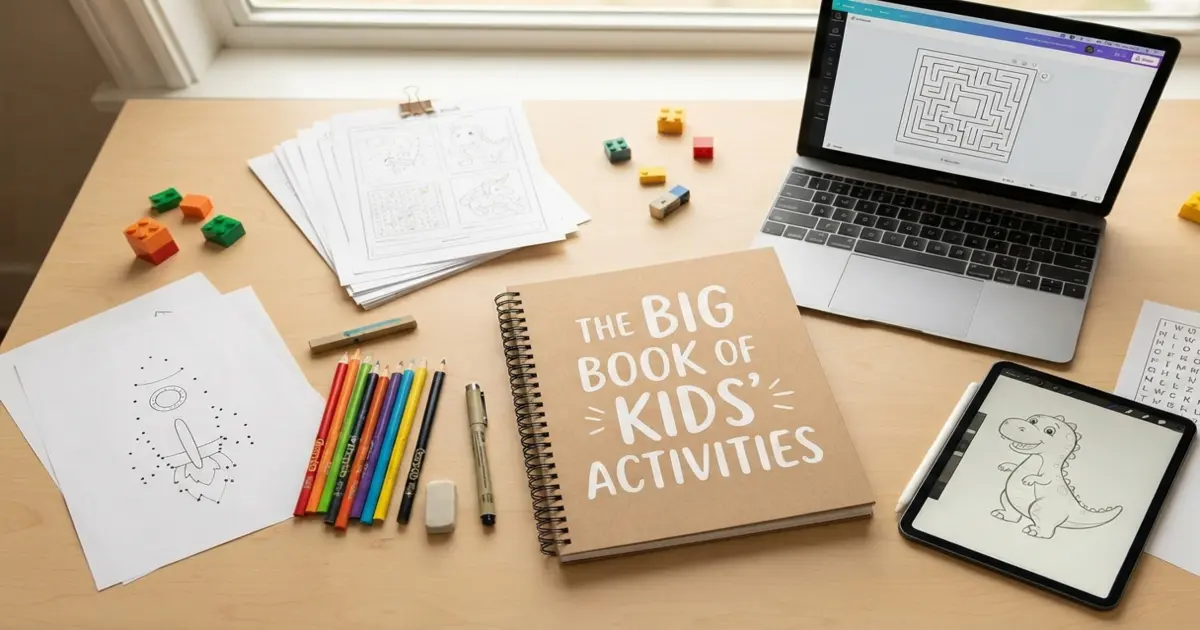
A kids activity book is one of the easiest products I’d point a beginner toward if they wanted to start publishing without going broke or losing their mind over deadlines. No plot to write. No characters to keep track of. Just pages that keep a kid busy for twenty minutes while a parent finally drinks a cup of coffee that isn’t cold. That’s the whole appeal, and honestly, that’s also why it sells so well across the US market.
This isn’t a “get rich overnight” post. It’s a walk-through of what actually goes into making one of these books, getting it in front of buyers, and pricing it so you’re not working for pennies.
What Is a Kids Activity Book, Really?
Mazes. Dot-to-dots. Coloring pages. Word searches. Simple tracing pages for little hands still learning to hold a crayon. Put a bunch of these together around one theme, and you’ve got yourself an activity book. It falls under what people in this industry call low content book publishing — meaning there’s barely any actual “content” to write, just a format to fill in over and over.
That’s exactly why it’s a good entry point. You don’t need to be a writer. You don’t need to be an illustrator either, if you’re smart about your tools (more on that in a second).
Why This Niche Still Makes Money
I’ve watched this category stay steady for years while other KDP niches came and went. A few reasons why:
- Parents want their kids off screens, even for an hour
- Homeschooling didn’t slow down after 2020 — it just became normal
- Printing costs are low since most people use print-on-demand
- One template can be reused for a dozen different themes
Put those together and you get a genuinely profitable low-content book category, which is more than you can say for a lot of the trendier KDP niches people chase.
Step 1 — Actually Pick a Good Niche First
Don’t skip this part. A lot of people jump straight to Canva without deciding what they’re making, and it shows in the final product. Good activity book ideas for kids usually fall into one of these buckets:
- Seasonal (Halloween mazes, Christmas coloring pages, Easter puzzles)
- Character-based (dinosaurs, space, unicorns, farm animals — pick something with staying power)
- Age-specific (toddlers, preschoolers, or the 7-10 crowd who want harder puzzles)
- Educational (letters, numbers, shapes)
Spend a real afternoon on this. Look at what’s already selling on Amazon with a few hundred reviews. That’s not luck — that’s proof people are buying.
Step 2 — Make Your Own Activity Book Without Overcomplicating It
Once you’ve got a niche, plan it out before you touch a design tool. When people make your own activity book for the first time, they usually either overthink it for weeks or rush it in a day and end up with something messy. Neither works.
Here’s roughly what I’d sketch out first:
- Page count — 40 to 100 pages is the sweet spot for most sellers
- Trim size — 8.5″ x 11″ is standard for US buyers, don’t overthink this one
- A rough mix of activity types so it’s not 60 pages of the same maze
- A basic template so every page shares the same margins and layout
Skipping this step is the fastest way to end up redoing half your book later.
Step 3 — The Best Tools to Design Activity Books
You genuinely don’t need Photoshop skills for this. Some of the best tools to design activity books that actual sellers use every day:
- Canva — free, has decent templates for mazes and worksheets already built in
- Adobe Illustrator or Affinity Designer — better if you want cleaner, scalable artwork
- Procreate — good for original illustrations if you’re drawing on an iPad
- KDP interior templates — pre-built to match Amazon’s exact trim requirements
If you’d rather not fight with margins and bleed settings yourself, this is where a design team can actually save you real time. We do this kind of work at Drawphics — helping people design children’s activity books that look like they came from a real publisher instead of a first attempt in Canva.
Step 4 — Building Printable Activity Books for Kids
There are two paths here, and they’re not the same thing:
Printable PDFs — sold on Etsy or your own site, downloaded and printed at home. Physical paperbacks — printed through Amazon KDP or another print-on-demand service and shipped to the buyer.
For printable activity books for kids, keep the file at 300 DPI, stick to standard US letter size, and check your margins so nothing important gets clipped when someone prints it on a regular home printer. For paperback, you’ll need to follow KDP’s bleed and margin specs exactly — they shift slightly depending on your page count, so don’t just copy the settings from your last book.
Step 5 — How to Publish on Amazon KDP
This part trips people up more than it should. Here’s the short version of a children’s book publishing guide for KDP:
- Set up a free KDP account
- Choose “Paperback” as the format
- Upload your interior PDF and cover file
- Pick your trim size, paper color, and binding
- Set a price, choose two categories, and add up to seven keywords
- Order a physical proof before you hit publish — always
That last step matters more than people think. I’ve seen books go live with a cover that looked fine on screen and terrible in print. Learning how to publish on Amazon KDP the right way the first time saves you an actual reprint bill later.
Step 6 — How to Sell Activity Books Online Outside Amazon
Amazon’s not the only place to make money here. If you want to spread your risk, here’s how a lot of sellers sell activity books online without relying only on KDP:
- Etsy, for instant-download printable versions
- Shopify, if you want your own storefront and better margins
- Teachers Pay Teachers, especially for anything educational
- Pinterest, which honestly drives more free traffic to this niche than people expect
If you want more of this kind of practical stuff, we cover it regularly on our blog.
Pricing It So You’re Not Working for Free
For a standard 40-60 page paperback at 8.5″ x 11″, most US sellers land somewhere between $5.99 and $8.99. Run the numbers through KDP’s royalty calculator before you commit to a price — printing costs eat more of your margin than people expect, especially on longer books. For printable PDFs, $3.99 to $6.99 tends to sell without feeling overpriced.
Mistakes That Quietly Kill Your Profit
- Picking a niche because it looks fun, not because it sells
- A cover that looks like it was made in five minutes (because it was)
- Too much blank space and not enough actual content
- Ignoring KDP’s exact specs and getting your file rejected
- Publishing without ever holding a printed proof copy
Most of these aren’t fatal mistakes. They’re just avoidable ones.
Final Thoughts
A profitable kids activity book isn’t complicated — it just takes a real niche, a clean design, and a plan for where you’re actually going to sell it. Start with one theme. See what the sales data tells you. Then repeat what worked. And if the design side isn’t your thing, that’s literally what we do at Drawphics — you can also browse more guides like this one on our blog page whenever you’re ready.
Frequently Asked Questions
1. What age group works best for a kids activity book?
Ages 4–8 are the sweet spot, though toddler (2–4) and older kid (8–12) versions also sell steadily on Amazon KDP and Etsy.
2. How much does it cost to make a kids activity book?
DIY with Canva can cost close to $0. Hiring a designer usually runs $50–$300 depending on page count and style.
3. Do I need to know how to draw?
Not really. Clip art, templates, and hired illustrators cover most of it. Canva alone gets plenty of beginners through their first book.
4. How many pages should a printable activity book have?
Most sellers land between 40 and 100 pages. KDP paperbacks usually need at least 24 pages depending on trim size.
5. Is this niche still worth it in 2026?
Yes. Screen-free, printable activities are still in steady demand with US parents, homeschoolers, and teachers alike.