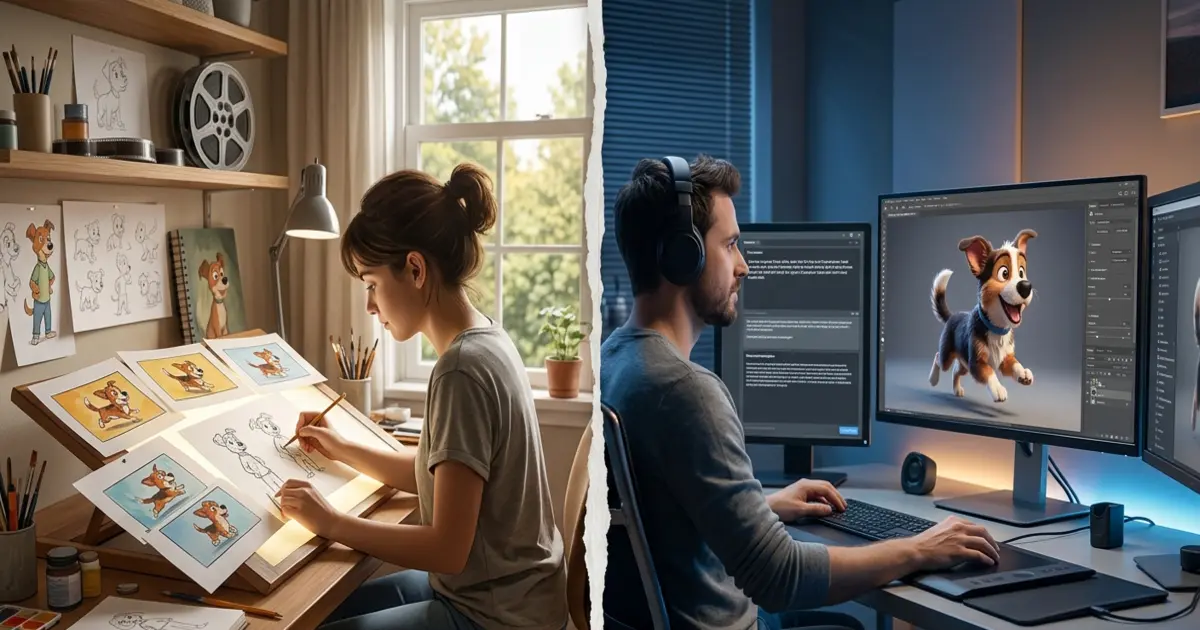
Somewhere between planning a launch video and staring at a shrinking marketing budget, most brands end up asking the same thing: AI vs traditional animation — which one is actually worth the money?
I get this question a lot, usually from marketing managers who’ve been burned once already, either by an AI clip that looked cheap on screen, or a traditional production that blew past deadline and budget. Neither is a scam. They’re just different tools, and picking the wrong one for the job is where things go sideways.
So let’s walk through it properly — no sales pitch, just what each option actually gives you.
What AI Animation Is (and Isn’t)
AI animation leans on machine-learning models to generate motion from a prompt, a still image, or a short reference clip. You type or upload something, the software predicts the in-between frames, and out comes a moving visual. Sounds simple. It’s not, really — someone still has to steer it, catch the weird glitches, and shape it until it actually looks like your brand instead of a random internet clip.
Where it earns its keep: quick social ads, rough concept previews, things that need to exist by Friday, not next month. Our AI animation work at Drawphics leans into speed without letting the output look like it was churned out by a machine and left untouched — because honestly, that’s the version people scroll past.
What Traditional Animation Is
Traditional animation — 2D, 3D, whatever the medium — is built by an actual person deciding what happens in every single frame. Every blink, every camera move, every little bounce in a character’s walk cycle. It’s slower because it’s handmade, in the same way a tailored suit takes longer than something off the rack.
This is still the go-to for mascots, feature-length explainers, and any commercial that needs to feel unmistakably yours five years from now. Our 2D & 3D animation team builds these from scratch, which is exactly why they hold up.
AI vs Traditional Animation: The Real Differences
| Factor | AI Animation | Traditional Animation |
| Speed | Hours, sometimes a day | Days, often weeks |
| Cost | Lower | Higher, scales with detail |
| Look | Can feel generic if untouched | Fully custom, recognizably yours |
| Best fit | Social ads, quick previews | Mascots, explainers, premium spots |
| Control | Broad, less frame precision | Total, down to every frame |
| Consistency | Can drift shot to shot | Locked in from start to finish |
Neither side “wins” here. That’s really the honest takeaway from the whole AI vs traditional animation debate — it depends what you’re making and why.
Cost of AI Animation vs Traditional Animation
Let’s talk actual money, since that’s usually the real question underneath everything else.
AI animation tends to cost less because you’re not paying a team to hand-draw or rig every second of footage. You’re paying for direction, prompting, and cleanup — which takes far fewer hours than full production.
Traditional animation costs more, and there’s a reason for that: storyboarding, character rigging, frame-by-frame polish, multiple rounds of revisions. A single minute of traditional footage can eat up more labor than a whole batch of AI-assisted clips.
If you’re pumping out a dozen short ad variations a month, the cost of AI animation vs traditional animation tips toward AI, no question. If you’re building the one hero video that’ll represent your brand for years, traditional usually earns back its price tag.
Animation Production Time — AI vs Traditional
Deadlines don’t care about your creative ambitions, so timing matters as much as budget.
AI can hand you a rough cut in hours. That’s why so many marketing teams use it to test five different ad hooks before committing real money to a full shoot or production.
Traditional animation takes longer, on purpose. Storyboards, animatics, rigging, rendering — a polished two-minute explainer can easily take a few weeks start to finish. Rushing it usually shows up on screen, which is why our explainer video process doesn’t try to shortcut that.
AI Animation Pros and Cons
What it’s good at:
- Turning ideas into visuals fast
- Costing less per finished asset
- Letting you test several directions before committing
- Previewing a concept before greenlighting a bigger budget
Where it falls short:
- Can look a little “off” without a skilled hand guiding it
- Limited control over exact timing and expression
- Might resemble other AI content if left untouched
- Struggles with longer, character-driven storytelling
None of this makes AI a bad option. It just means it’s a tool, not a magic wand.
Benefits of Traditional Animation
Here’s what traditional animation still does better than anything else on the market:
- It’s genuinely yours — no dataset, no borrowed style, just your mascot and your voice
- Full control over comedic timing, pacing, and emotional beats
- Consistency across every scene, every future video, every platform
- It ages well — a well-made traditional piece can anchor a brand for years without looking dated
If the video is going on your homepage, in front of investors, or airing as a TV spot, that extra cost usually buys real staying power.
AI Video Generation for Business — Where It Actually Pays Off
AI video generation for business works best in a few specific lanes, not as a blanket replacement for everything:
- Social ad variations — testing several hooks in a day instead of a week
- Internal previews — showing stakeholders a rough concept before locking a budget
- Personalized clips at scale — templated content for email or retargeting
- Fast prototyping — visualizing a script before the final creative direction is locked
Think of it as a faster first draft, not the finished masterpiece.
Commercial Animation Styles Worth Knowing
Whichever route you pick, the style still needs to match your audience:
- Whiteboard animation for B2B explainers — see our whiteboard animation service
- 2D character work for approachable, story-driven brand videos
- 3D for product visualization and tech-forward brands
- Motion graphics for data-heavy SaaS explainers
- AI-stylized visuals for bold, fast-moving social campaigns
Commercial animation styles aren’t just an aesthetic choice — they change how your audience processes and remembers the message.
Hybrid Animation Workflow: The Middle Ground Most Studios Actually Use
Most experienced studios don’t treat this as either/or. A hybrid animation workflow uses AI for the early, fast stuff — rough animatics, background generation, concept boards — then hands the final polish to human animators for character work and brand-specific detail.
You get speed without losing the craftsmanship that makes something feel premium. It’s roughly how we approach our own animation services — using whichever tool actually fits the stage of the project, instead of forcing one method to do everything.
So — AI vs Traditional Animation, Which Fits Your Brand?
Ask yourself three quick questions:
- Is this a short-lived social ad, or a video you’ll use for years? Short-lived leans AI. Long-term leans traditional.
- Does it need a distinct character or mascot people will recognize? That’s traditional’s territory.
- What’s the real deadline? Days away, lean AI or hybrid. Weeks available, traditional gives you more room to get it right.
There’s no wrong answer — just the tool that fits the job you actually have in front of you.
Why Brands Across the USA Work With Drawphics
We don’t pick a side in the AI vs traditional animation conversation. We build with whichever approach actually serves the brand in front of us, based on budget, timeline, and the story that needs telling — not a one-size template.
Take a look at our portfolio for real examples of both AI-assisted and fully traditional work, or head over to contact us to talk through what your next project needs. You can also read more about how we work on our about us page, or browse more breakdowns like this one on our blog.
FAQs
1. Is AI animation cheaper than traditional animation?
Usually. AI cuts down manual labor hours, making it more affordable for short clips and quick concepts.
2. Can AI animation fully replace traditional animators?
No. AI speeds up early drafts, but skilled animators still handle timing, depth, and brand polish.
3. Which is better for a business explainer video?
Traditional or hybrid animation tends to work better for explainers needing consistent characters.
4. How fast is AI animation compared to traditional methods?
AI can deliver drafts in hours. Traditional animation often takes days to weeks, depending on complexity.
5. What is a hybrid animation workflow?
It pairs AI for fast early drafts with human animators for final polish — balancing speed and quality.