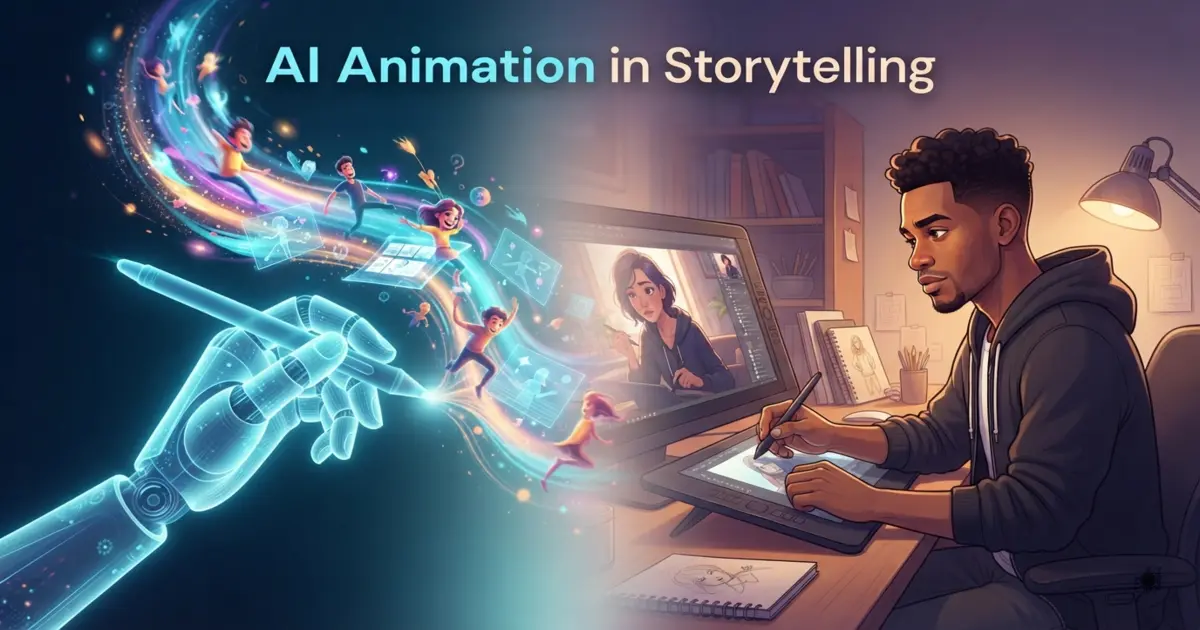
AI Animation in Storytelling stopped being a buzzword a while ago. It’s already sitting inside real production pipelines — an indie YouTuber in Austin uses it to rough out a scene overnight, a marketing team in New York uses it to test three concepts before lunch. Honestly, if you’ve scrolled your feed this week, you’ve probably watched something AI-assisted without clocking it.
Here’s the part people skip over though: it’s not a magic fix. It’s a tool. Brilliant in the right hands, kind of a mess in the wrong ones. So let’s actually get into what AI Animation in Storytelling does well, where it still falls flat, and why most creators in the USA aren’t picking a side — they’re just using both.
What Is AI Animation in Storytelling, Exactly?
Quick definition before the pros and cons, because the term gets thrown around loosely. AI animation leans on machine learning models to generate or speed up parts of the animation process — character motion, backgrounds, style transfer, lip-syncing, rough scene layouts, that kind of thing. Instead of hand-animating every single frame, a creator feeds in a prompt, a sketch, or reference footage, and the system spits out a base version that a human then cleans up and finishes.
What digital storytelling with AI is really doing is shrinking the gap between an idea in someone’s head and something watchable on a screen. That used to take weeks. Now, depending on the format, it can take days.
Want to see what that looks like outside of a demo reel? Our AI Animation services page breaks down how we mix AI speed with hand-finished motion design for clients who need both — because most of them do.
How Is AI Used in Storytelling?
We get asked this a lot, so here’s the short version. Right now, AI shows up mainly in:
- Concept visualization — turning a script or mood board into rough scenes before real production starts
- Style generation — keeping an art style consistent across dozens of frames instead of redrawing everything by hand
- Motion assistance — generating in-between frames or rough movement that an animator then polishes
- Voice-to-animation syncing — matching mouth movement to dialogue without manual frame-by-frame work
- Environment building — filling out backgrounds faster than traditional matte painting ever allowed
None of that replaces the person directing the story. It just changes where their hours go. Less time spent redrawing the same in-between frame twelve times, more time spent on pacing and the moments that actually make someone care what happens next.
The Benefits of AI Animation
Let’s start with what’s genuinely working, because there’s a lot. This isn’t theoretical — it’s why studios and solo creators across the country keep pulling AI into their workflow despite the learning curve that comes with it.
Speed changes everything about the timeline. Traditional 2D or 3D work can eat weeks on even a short sequence. AI-assisted drafts cut that down hard, which means creators can test an idea and pivot before burning full production hours on something that wasn’t going to work anyway. For anyone running on a tight marketing calendar, that alone changes what’s possible.
It lowers the barrier for smaller creators. Not everyone has a studio-sized budget. AI animation gives solo YouTubers, small business owners, and indie game devs a shot at producing something that used to require a full team. That’s probably the single biggest shift in this industry over the last two years — full stop.
Creative direction moves faster too. When a client wants to see three different visual takes on the same scene, AI can rough those out in an afternoon instead of a week, which saves the back-and-forth that used to slow projects down.
Consistency gets easier on long projects. Keeping a character’s proportions and color palette steady across a twenty-minute explainer video used to mean someone manually tracking every detail. AI trained on a defined style can hold that line at scale, and that matters more than people give it credit for.
And it opens the door to experimenting. Effects that would’ve taken a specialist weeks to nail by hand can now get prototyped in hours — which means more room to try something unconventional before committing real budget to it.
What Are the Advantages of AI Animation for Content Creators?
Is AI animation good for content creators? Mostly, yes. But there’s a catch. The advantage isn’t that AI does the creative thinking for you — it’s that it clears out the parts of the process that were never creative in the first place: cleanup, repetitive in-betweening, basic scene assembly. Creators who already understand storytelling get more done in the same number of hours. Creators who don’t just end up producing more forgettable content, faster than before.
That distinction is the part most articles about the future of animation and AI conveniently leave out.
The Drawbacks of Using AI in Video Production
Now the part that doesn’t get talked about enough. AI animation has real limits, and pretending otherwise doesn’t do anyone favors.
Emotional nuance is still the weak spot. AI-generated motion can look technically smooth and still feel completely flat. The tiny hesitation before a character speaks, the timing on a comedic beat, the weight in a pause — trained animators just get this in a way models haven’t caught up to yet. It’s improving, sure, but it’s not there.
Output quality isn’t always consistent either. Ask a tool to generate the same character twice and you might get two slightly different results. Without a skilled animator standardizing things afterward, that inconsistency shows up fast, especially in close-ups where every small mismatch is obvious.
Fine control is another sticking point. Directors often need something specific — an exact camera angle, one particular hand gesture, a prop placed just so. AI is getting better at this, but it’s still nowhere near as reliable as a human following a detailed storyboard frame by frame.
Then there’s the copyright question nobody’s fully answered. Because a lot of these models train on huge datasets scraped from existing creative work, originality and ownership are still murky legal territory in the US. Brands protective of their visual identity should be paying attention here.
And maybe the quietest problem: it can flatten creative risk-taking. When the “safe” output is the easiest one to generate, there’s a real pull toward just using what the AI suggests instead of pushing for something more original. Left unchecked, entire niches start looking the same.
AI Animation Pros and Cons: A Quick Side-by-Side
| What Works Well | What Still Needs a Human Touch |
| Fast first drafts and rough previsualization | Emotional timing and subtle expression |
| Lower cost for early-stage content | Precise creative control and detail |
| Style consistency across long videos | Original, brand-distinct visual identity |
| Great for experimentation and testing ideas | Complex character rigging and nuanced motion |
The Future of Animation and AI
Nobody credible is out here saying AI will fully replace animators — that’s not really the conversation anymore. What’s actually happening is a shift toward hybrid production, where AI handles the repetitive groundwork and skilled artists handle direction, refinement, and the emotional core that makes a story land. The studios figuring out that balance early are the ones putting out work that feels both fast and genuinely well made.
That’s basically the model behind good 2D & 3D animation work today — AI speeds the pipeline up, but a trained eye still shapes every scene. Even character design benefits from this pairing. AI can spit out a dozen variations in minutes, but it’s still a designer deciding which one actually fits the story.
Over the next few years, expect digital storytelling with AI to push further into interactive formats, personalized video, and faster turnarounds on marketing assets. The tools will keep getting better. The need for a person guiding them isn’t going away, though — if anything, it’s becoming the whole point.
Should You Use AI Animation for Your Next Project?
If you’re a small business owner in the US trying to get a product explainer out the door on a tight deadline, AI Animation in Storytelling can genuinely save you time and money in the early stages. If you’re building a brand that needs to feel distinct and memorable, though, you’ll still want experienced hands steering the final output — that part hasn’t changed.
Most creators doing this well aren’t choosing AI over traditional animation. They’re combining both. That’s the approach behind every project we take on, blending AI-driven speed with the kind of hand-finished detail that actually makes a story land. Take a look at our portfolio to see what that blend looks like in practice, or check out our About Us page to see how our team thinks about each brief.
Got a project in mind? Reach out to our team and we’ll talk through what makes sense for it.
Frequently Asked Questions
How is AI used in storytelling?
AI helps with concept visualization, style consistency, motion generation, and voice syncing, while human animators still guide pacing, emotion, and final creative direction.
What are the advantages of AI animation?
Faster production timelines, lower costs on early drafts, easier style consistency, and more room to test different creative directions before locking anything in.
Is AI animation good for content creators?
Yes, especially for small creators and startups needing faster, more affordable content — though the best results still come from pairing it with human judgment.
What are the drawbacks of using AI in video production?
Weaker emotional nuance, inconsistent output, less precise creative control, and unresolved copyright questions tied to how these models are trained.
What is the future of animation and AI?
A hybrid setup where AI handles repetitive groundwork like drafts and in-betweening, while animators focus on story, emotion, and original visual identity.