So you finally finished writing your children’s book. The story is there. The characters exist in your head — clear as day. And now you’re staring at a blank screen, googling how to hire a children’s book illustrator for KDP 2026, wondering where to even start.
Here’s the honest truth most guides skip over: hiring the wrong illustrator doesn’t just cost you money. It can cost you months of revisions, a rejection from Amazon KDP, and sometimes the entire project falling apart before a single kid gets to read it.
This guide exists so that doesn’t happen to you.
We’ve broken down everything — from KDP’s formatting requirements and bleed rules to what it actually costs to hire someone good, what your contract should say, and how to make sure you own the art you paid for. Whether you’re publishing a picture book, a board book, or an early reader on Amazon, this is the 2026 playbook you need.
Why Hiring the Right KDP Illustrator Actually Matters in 2026
Amazon KDP is not a forgiving platform when it comes to file quality. If your illustrations aren’t submitted correctly — wrong DPI, missing bleed, bad color mode — your book either gets rejected outright or prints with white edges, color shifts, and blurry images that look nothing like what you approved.
That’s not a small problem. That’s the kind of thing that gets your book a one-star review before a reader even opens the cover.
A skilled children’s book illustrator who understands KDP children’s book formatting requirements knows to set up every file correctly from the very first sketch — not as an afterthought at the end. That’s the difference between a professional who works with KDP authors regularly and a general freelancer who’s never touched a print-ready PDF in their life.
At Drawphics, we work with self-publishing authors across the United States specifically on KDP projects. We’ve seen what happens when formatting gets ignored. And we’ve fixed enough of those files to know exactly what you should be asking before you sign any agreement.
Step 1: Know What You’re Publishing Before You Hire Anyone
Before you even look at a portfolio, you need to know what kind of book you’re making. This matters because KDP treats different book formats completely differently — and that affects what your illustrator needs to deliver.
Picture Books (Ages 2–8) — typically 24 to 32 pages, full-spread illustrations, high visual complexity. Every page spread is its own world. These are the most illustration-heavy projects and cost the most.
Early Readers (Ages 5–10) — text plays a larger role, illustrations support the story rather than carry it. Fewer full-spread images, more spot illustrations per page.
Activity Books and Coloring Books — line art heavy, sometimes no color at all in the interior. Lower per-page cost but still needs clean vector or high-resolution files.
Board Books — short page count, but KDP’s specifications for board books differ from standard paperbacks. Not every illustrator knows this.
Knowing your format upfront helps you filter out illustrators who don’t have relevant experience and lets you ask the right questions from day one.
Check out Drawphics’ KDP children’s book illustration service to see what a properly formatted KDP project actually looks like before you start hiring.
Step 2: Understand KDP Children’s Book Formatting Requirements
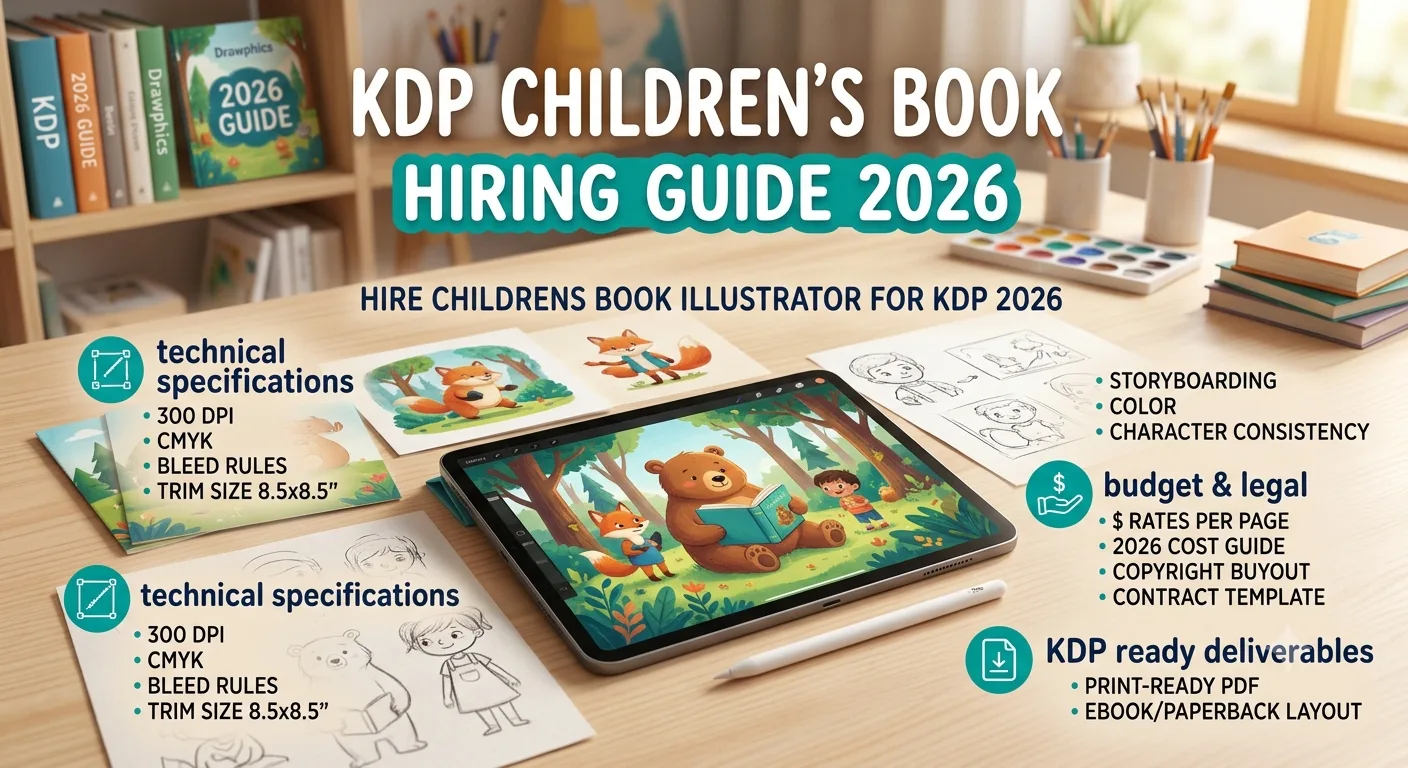
This is where most first-time self-publishers get burned. Amazon KDP has specific technical requirements, and they’re non-negotiable. Your illustrator needs to know all of these cold.
Trim Size
KDP supports several trim sizes, but for children’s books in the US market, the most common are:
- 8.5 x 8.5 inches — square format, very popular for picture books
- 8.5 x 11 inches — tall format, great for portrait-style illustrations
- 6 x 9 inches — standard for early reader chapter books
Your illustrator should be working at your chosen trim size from the very first draft. Trying to resize illustrations after the fact almost always causes problems — image quality loss, composition issues, and misaligned text areas.
Amazon KDP Bleed and Trim Size Rules
Bleed is the extra space around your artwork that goes beyond the trim edge. KDP requires a 0.125-inch bleed on all sides for paperback books with full-bleed illustrations.
This means your illustrator needs to extend backgrounds and artwork past the trim line so that when the book is cut during printing, there are no white edges. If they’re not building bleed into every file, your finished book will have thin white borders around every illustration — and it will look amateur.
Safe zone matters too. KDP recommends keeping all important content — faces, text, key visual elements — at least 0.25 inches inside the trim edge. This prevents anything critical from getting cut off during the physical print-and-cut process.
Resolution: 300 DPI Minimum
Every interior illustration needs to be at 300 DPI (dots per inch) at the final print size. This is non-negotiable for sharp, professional printing. Screen-resolution artwork (72 DPI) will print blurry and pixelated.
A lot of freelancers on budget platforms submit at 150 or 200 DPI and claim it’s “fine.” It’s not. When a printing house enlarges an underpowered image, the quality degradation is visible to any parent flipping through the book in a store — or reviewing the preview on Amazon.
Color Mode: CMYK
KDP prints in CMYK, not RGB. This matters because colors that look vibrant on a computer screen can shift — sometimes dramatically — when converted to CMYK for printing. Blues can go slightly purple. Bright oranges can go muddy.
Your illustrator should be working in CMYK from the start, not converting at the end. If they’re designing in RGB and doing a final conversion, there will be color shifts — and you might not notice until your first print proof arrives.
Print-Ready PDF for KDP
Your final delivery from the illustrator should be a print-ready PDF that complies with KDP’s file specifications. This means:
- PDF/X-1a or PDF/X-4 format preferred
- All fonts embedded (if text is part of the layout)
- Correct trim and bleed marks
- No crop marks overlapping the live area
- All images at 300 DPI at final size
If your illustrator hands you a bunch of loose JPEG files and says “good luck,” that’s not a finished deliverable for KDP.
Step 3: KDP eBook vs. Paperback Illustration Layout
This catches people off guard. A lot of authors want both a Kindle eBook version and a paperback on Amazon. The problem is that the illustration layout for each format is completely different — and your illustrator needs to prepare separate files.
Paperback: Fixed page dimensions, bleed required, high-resolution raster or vector files. The layout is built around a physical page spread, including the spine width which changes based on page count.
KDP eBook (Kindle): Reflowable vs. fixed-layout formats. Children’s picture books almost always need to be submitted as fixed-layout ePub so the illustrations and text stay exactly where you put them. If submitted as reflowable, Amazon will try to reformat the content and everything falls apart.
Fixed-layout Kindle books have their own image requirements — typically 72–150 DPI is acceptable for screen display, but the image dimensions need to be large enough to look sharp on high-resolution iPad and Kindle screens.
Your illustrator should be delivering separate optimized assets for each format. If they tell you “the same files work for both,” ask them to prove it — because usually they don’t.
Step 4: How Much Does It Cost to Hire a Children’s Book Illustrator in 2026?
Let’s talk real numbers. This is one of the most searched questions in the self-publishing world, and most answers are either outdated or vague. Here’s what the U.S. market actually looks like in 2026.
Children’s Book Illustrator Cost Per Page
The average rate for children’s book illustration in the United States breaks down roughly like this:
| Illustrator Level | Per-Page Rate (Interior) | Full Project (32 pages) |
| Entry-Level Freelancer | $50–$150 | $1,600–$4,800 |
| Mid-Level Professional | $150–$350 | $4,800–$11,200 |
| Experienced/KDP Specialist | $300–$600 | $9,600–$19,200 |
| Top-Tier/Published | $600–$1,200+ | $19,200–$38,400+ |
These are interior page rates. Cover illustration is typically priced separately and often runs 1.5–2x the per-page rate, since the cover carries the most visual weight and needs to compete in Amazon’s thumbnail-sized search results.
What Affects Price?
Several factors move the needle on children’s book illustrator cost per page:
Style complexity — Loose watercolor takes different time than detailed digital painting. Highly rendered character work with complex backgrounds costs more than simple line art.
Character count per spread — A scene with five characters interacting is a fundamentally different amount of work than a single character in a white environment.
Revision rounds included — Some illustrators include one round of revisions per illustration. Others include three. Make sure you know what you’re buying before work starts.
Commercial rights and copyright buyout — We’ll cover this in detail below, but the price changes significantly depending on what rights you’re acquiring.
Timeline — Rush jobs cost more. If you need a 32-page book illustrated in three weeks instead of three months, expect to pay a premium.
Want to see what professional KDP illustration looks like at Drawphics? Visit our custom children’s book illustration service to explore our work and request a quote.
Step 5: The Children’s Book Illustrator Contract Template — What Must Be in It
Before any work starts, you need a written agreement. Not a text message. Not an email thread. A proper contract. This protects both you and the illustrator, and it prevents the most common disputes that happen in creative projects.
Here’s what every children’s book illustrator contract for KDP publishing should include:
Scope of Work
Spell out exactly what’s being created. Number of pages. Number of character designs. Whether cover illustration is included. Whether the illustrator is doing layout/formatting or just delivering raw artwork files. Ambiguity here is what creates disagreements later.
Deliverables and File Format
Be specific about what you’re receiving. CMYK TIFF or PSD files at 300 DPI? A print-ready PDF assembled to KDP specs? Individual page files plus a compiled interior PDF? Don’t assume — write it down.
Revision Policy
Define how many rounds of revisions are included. A standard professional arrangement is two rounds of revisions per illustration, with additional rounds billed at an hourly rate. If you don’t define this, you can end up in a situation where you’re asking for change number twelve on the same spread — and the illustrator is either burned out or charging you by the hour without you realizing it.
Book Illustration Revision Policy best practice: The first revision round should happen at the sketch/rough stage — before color or rendering is applied. This is your chance to fix composition, character expressions, perspective, and storytelling. Getting changes at sketch stage is fast. Getting them after full rendering is expensive and time-consuming for both sides.
Payment Schedule
For projects over $1,500, a milestone-based payment structure is standard in the US market. A common split:
- 30–40% upfront (to begin work and hold the timeline)
- 30–40% at sketch approval (mid-project milestone)
- 20–30% on final delivery
Never pay 100% upfront to anyone you haven’t worked with before. Never ask an illustrator to deliver 100% of work before receiving any payment — they won’t agree to it, and they shouldn’t.
Timeline
Written deadlines. For each phase: character concepts, rough sketches, color comps, final art, and file delivery. Include what happens if the client is slow to approve — because project delays almost always come from client feedback lag, not illustrator pace.
Step 6: Copyright Buyout for Book Illustrations — Who Owns the Art?
This is the question most first-time authors don’t think to ask — until they want to license their book to a publisher, sell merchandise, or turn it into an animated series. Then it becomes urgent.
By default in the United States, the creator of an artwork owns the copyright to that work — even if you paid them to make it. The payment doesn’t transfer ownership. Only a written agreement explicitly transferring copyright does.
What Is a Copyright Buyout?
A copyright buyout for book illustrations means the illustrator transfers all ownership of the artwork to you, the client. After a buyout, you own the illustrations outright. You can use them anywhere, in any format, in any market, forever, without paying the illustrator anything additional.
Copyright buyouts cost more than limited-use licensing. Often 20–50% more than the base illustration rate. But for KDP self-publishers who plan to use their book commercially — selling it on Amazon, licensing it, creating merchandise, pursuing traditional publishing deals — a full buyout is worth the additional cost.
Commercial Usage Rights for Self-Publishing
If a full copyright buyout isn’t in your budget right now, make sure your contract at minimum includes commercial usage rights for self-publishing. This means you have the right to sell the illustrated book on Amazon KDP and other retail platforms for commercial gain.
Without commercial usage rights explicitly stated in writing, an illustrator could technically argue that your sale of the book on Amazon infringes their copyright — even though you paid them to make the illustrations. This is rare, but it happens.
Minimum rights your contract should grant you:
- Right to reproduce the artwork in print (paperback, hardcover)
- Right to reproduce the artwork in digital format (eBook)
- Right to sell the finished book commercially on any retail platform
- Right to use cover art in marketing and promotional materials
If you want to later license your book internationally, create an animated adaptation, or sell merchandise based on your characters, you’ll need broader rights — ideally a full copyright buyout.
Visit Drawphics’ illustrator services to learn how we handle rights and ownership for every project we take on.
Step 7: Where to Actually Find and Vet KDP Children’s Book Illustrators
You have several options, and each has real trade-offs.
Freelance Marketplaces (Fiverr, Upwork, Reedsy)
The widest selection and the widest range of quality. You can find extraordinary work and genuinely bad work on the same platform within five minutes of each other. The challenge is vetting — because anyone can post a portfolio that doesn’t accurately represent what they’ll actually deliver for your project.
What to look for: KDP-specific experience (ask directly), samples of finished, printed books (not just digital illustrations), and reviews from other children’s book authors specifically.
Red flags: Very low prices for complex work, no examples of formatted book interiors, vague answers about file delivery formats, no written contract offered.
Dedicated Illustration Studios
Studios that specialize in children’s book illustration for self-publishers tend to have cleaner processes, better file delivery, and more reliable communication than solo freelancers. They often cost more, but the structured process reduces your risk significantly.
At Drawphics, we work exclusively with authors on projects that require both creative quality and technical precision — including full KDP formatting, print-ready file delivery, and commercial rights included in every agreement.
Word of Mouth and Author Communities
KDP authors talk to each other. Facebook groups like “KDP Authors” and “Self-Publishing School Community” are full of authors who’ve hired illustrators and will tell you honestly who was good and who wasn’t. This is often the most reliable sourcing method — if you can find someone who’s already been through exactly what you’re planning.
Portfolio Red Flags to Watch For
- Illustrations that look beautiful but have no examples of how they’d look in a formatted book
- Portfolio samples that are all digital-only, with no print work shown
- Styles that look inconsistent across a portfolio (this can mean they’re showing stock art or AI-generated samples)
- No character consistency across multiple scenes (a critical skill for children’s books where the same characters appear repeatedly)
Character consistency is worth emphasizing. In a children’s book, your main character appears on nearly every page — sometimes from different angles, at different ages, in different environments. An illustrator who can’t maintain consistent character proportions, features, and personality across a 32-page book will produce something that looks like several different books smashed together. Always ask for a multi-page sample featuring the same character in different scenes.
Step 8: Evaluating a Style Portfolio for Your KDP Book
Not every illustration style works for every children’s book. And not every beautiful style translates well to KDP’s print process.
Watercolor and gouache styles print beautifully on KDP’s standard color interior. The soft edges and natural color variation work well within CMYK printing. These styles also tend to photograph warmly for Amazon product images.
Flat digital illustration (bold shapes, limited palette, clean lines) is extremely popular in children’s publishing right now, particularly for younger age groups. It’s very forgiving in print and tends to look sharp even on KDP’s standard paper options.
Highly detailed realistic illustration is gorgeous but risky on KDP’s paper. KDP’s premium color interior paper is decent, but it’s not fine art printing. Subtle details in highly realistic work can get lost in the CMYK printing process.
Line art / coloring book style works perfectly on KDP’s black-and-white interior, which is significantly cheaper per page than color. For activity books, educational books, and coloring books, this is the most cost-effective approach.
Explore our 2D illustration service and watercolor illustration service to see how different styles translate to print-ready book interiors.
Step 9: The Project Workflow — From Hire to Published
Understanding the production timeline helps you set realistic expectations and plan your launch properly.
Week 1–2: Onboarding and character design The illustrator reviews your manuscript, develops initial character concept sketches, and gets your approval on the visual direction before any interior pages are started.
Week 2–4: Rough sketch phase All interior pages are roughed out as loose sketches. This is your most important feedback opportunity — composition, storytelling, pacing. Get all structural changes done here.
Week 4–8: Color and rendering Approved sketches get color, texture, and detail applied. Minor adjustments can still happen, but major compositional changes are expensive at this stage.
Week 8–10: Final file assembly All pages compiled into a print-ready PDF following KDP’s formatting requirements. Cover designed to KDP’s cover calculator specifications. Both print and digital versions prepared if needed.
Week 10–11: Proof and revisions You review the complete assembled book. Minor text and color adjustments made. Final files delivered.
Week 12+: You upload to KDP With your print-ready PDF in hand, you upload to KDP’s publishing platform, order a physical proof copy, review it, and approve for distribution.
Realistic timelines for a 32-page children’s picture book run 10–14 weeks from contract signing to final file delivery when working with an experienced illustrator. Anyone promising a fully illustrated 32-page book in two weeks is either sacrificing quality or planning to use AI-generated images, which creates its own set of problems for KDP.
Step 10: Protecting Yourself After the Work Is Done
Your relationship with your illustrator doesn’t end at file delivery. There are a few things to lock in before you close out the project.
Get all native files. When your contract calls for it, make sure you receive the original working files (PSD, AI, Procreate, etc.) — not just flat exports. If you ever need to make updates years from now and can’t reach the original illustrator, having the native files means another professional can pick up the work.
Confirm kill fees if you need to cancel. If a project falls through mid-production, the standard industry practice is that completed work is compensated. Know before you start what happens if you need to pause or cancel — most professional illustrators have a kill fee clause (typically 25–50% of remaining balance for work already completed).
Keep your signed contract and all email correspondence. If a rights dispute ever comes up later, documentation is everything.
Register your copyright. As the author (and copyright holder under your buyout agreement), you can register the copyright for your finished book with the U.S. Copyright Office at copyright.gov for a nominal fee. This gives you legal standing if anyone infringes your work.
The Drawphics Difference: KDP-Ready From Day One
At Drawphics, we’re a creative illustration studio based in the United States, and we’ve built our entire KDP children’s book service around what actually matters: clean files, correct formatting, and illustrations that tell your story the way you imagined it.
Every KDP project we deliver includes:
- Full CMYK color workflow from sketch to final file
- 300 DPI print-ready files formatted to your chosen KDP trim size
- Correct bleed and safe zone setup on every page
- Print-ready PDF for paperback interior
- Separate optimized files for Kindle fixed-layout ePub if needed
- Commercial usage rights included as standard
- Full copyright buyout available
We also bring real creative experience to every project. Our character design service ensures your characters look consistent across every single page of your book — something that matters enormously for children who fall in love with your characters and expect them to look the same from page 1 to page 32.
View our illustration portfolio to see the quality of our work, or contact us to talk through your project and get a custom quote.
You can also browse our illustrator services page for a full breakdown of every type of illustration we offer — from book cover design to activity books to digital concept art.
Final Thoughts: Hire for the Whole Project, Not Just the Art
The biggest mistake first-time KDP authors make is hiring an illustrator purely based on style and price, then discovering mid-project that the person they hired doesn’t understand KDP formatting, can’t deliver a print-ready file, and has never actually had a book printed in their life.
When you hire a children’s book illustrator for KDP 2026, you’re not just buying pretty pictures. You’re buying the technical knowledge to get those pictures onto Amazon’s platform correctly, the professionalism to stick to a timeline and revision process, and the legal clarity to know exactly who owns the art when the project is done.
Get those three things right, and you’ll have a book you’re proud of — one that prints beautifully, looks sharp on Amazon’s listing page, and actually sells.
If you have questions about your project or want to see if Drawphics is the right fit, we’d love to hear about what you’re building. Get in touch here — no pressure, just a real conversation about your book.
Frequently Asked Questions
Q1: How much does it cost to hire a children’s book illustrator for KDP in 2026?
Rates range from $50–$150/page for entry-level to $300–$600/page for experienced KDP specialists. A full 32-page picture book typically costs $4,800–$19,200 depending on style and complexity.
Q2: What is the correct bleed size for Amazon KDP children’s books?
KDP requires 0.125-inch bleed on all sides for paperback books. Keep key content 0.25 inches inside trim edges to avoid getting cut during printing.
Q3: Do I own the illustrations after paying an illustrator?
Not automatically. You must have a written contract specifying copyright buyout or commercial usage rights. Without this, the illustrator retains ownership by default under US copyright law.
Q4: What file format should my KDP illustrator deliver?
A print-ready PDF (PDF/X-1a or PDF/X-4) at 300 DPI in CMYK color mode, built to your book’s trim size with correct bleed, is the standard professional deliverable for KDP paperback publishing.
Q5: How long does it take to illustrate a children’s book for KDP?
A professional 32-page picture book takes 10–14 weeks from contract to final delivery. Rush timelines cost more and usually sacrifice quality. Plan ahead for your launch date.
Need expert KDP children’s book illustration? Explore Drawphics’ illustration services or contact the team to start your project today.