Choosing between an AI vs human illustrator for children’s books is becoming a common decision for authors. Selecting the right illustration method determines both your budget and your book’s marketability. Generative AI tools promise low costs and instant image generation, making them tempting for independent authors on tight budgets. Authors often compare AI tools with professional children’s book illustration services to understand which option fits their storytelling goals.
Custom human illustration brings visual storytelling, emotional connection, and character continuity that holds the reader across the 32-page manuscript together. While AI can accelerate early ideation, Amazon KDP compliance and full copyright ownership are still crucial. A custom artist protects your brand through print-ready formatting Understanding the practical, technical, and legal differences in the AI vs human illustrator for children’s book debates helps you to evaluate how each option affects your workflow.
AI vs Human Illustrator for Children’s Books: Key Differences
| Factor | AI-Generated Illustration | Human Illustrator |
| Cost | Usually cheaper at the start | Usually costs more |
| Production Timeline | Minutes to hours per image | Take more time, days to weeks. |
| Character Continuity | May change between scenes | Easier to keep the same |
| Copyright Eligibility | Pure AI art may have copyright limits | Fully protectable as original work |
| Amazon KDP Compliance | AI-generated art must be disclosed. | No AI disclosure needed |
| File Print-Readiness | Rarely native 300 DPI or CMYK-calibrated | Delivered print-ready with bleed and CMYK |
AI wins on speed and price. Human illustration wins on ownership, consistency, and the kind of visual storytelling that a 32-page manuscript actually demands.
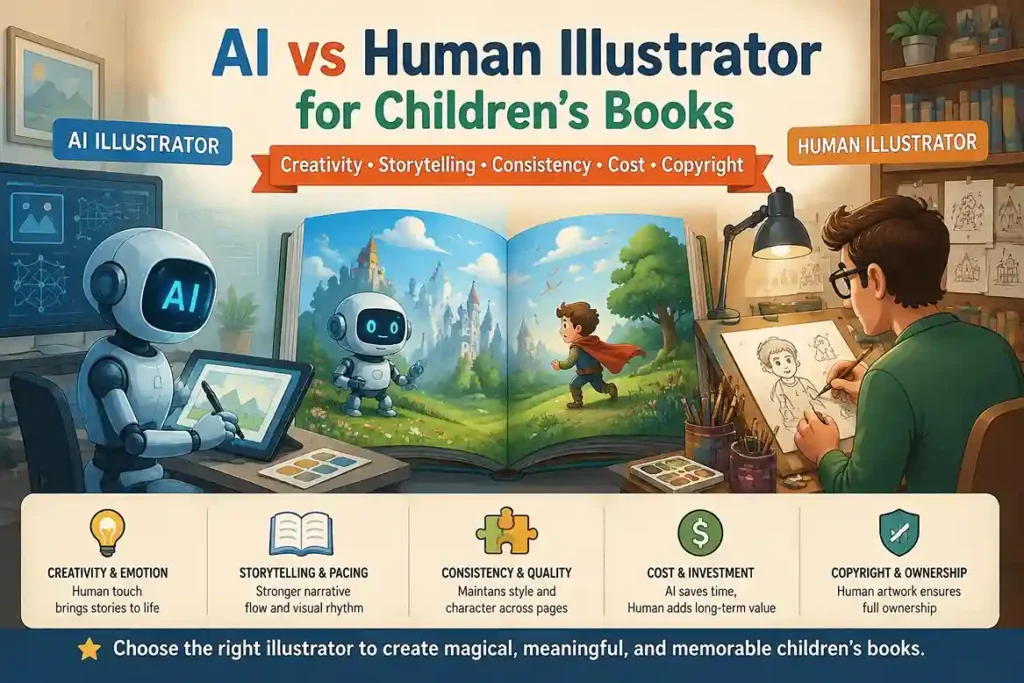
AI Illustration for Children’s Books: Benefits and Challenges
AI is especially useful during early visual deployment. An author can test different environments, color directions, or character ideas for what the finished book should look like. For example, an author may know the story takes place on a farm but still be unsure whether the book should feel realistic, whimsical, or softly watercolor-based. Rough visual references can make that decision easier.
The distinction that matters here is between early ideation and final artwork. A prompt-generated mockup used internally to understand the work is a planning tool. The same image, dropped into a finished manuscript and sold on Amazon, is a different thing entirely, one with copyright gaps and disclosure obligations attached.
Treating AI as a sketchbook rather than a printer works well. Treating it as the final illustrator tends to create problems downstream, in areas competitors covering this topic rarely walk through in detail: character drift, color shifts at print, and thin legal footing.
Human Children’s Book Illustrators: Creativity and Storytelling
Narrative Depth and Visual Subtext
- A professional children’s book illustrator does more than render what’s written. They project visual humor in a background detail; the manuscript might never say that stubborn dog is stealing biscuits in the background, but the illustrator can build this by spreading small visual jokes across the sections
- The illustrator gives a side character a private storyline that unfolds only in the art and uses a character’s posture to communicate an emotion the text never states directly. These choices come from understanding the whole manuscript, not from optimizing a single frame.
Layout Precision and Composition
- Picture books are read as much as they’re looked at, and a human illustrator designs around that fact. They leave room for text, consider where a child’s eye lands first on a spread, and build in a sense of anticipation before a page turn, the pacing device that keeps young readers engaged
- AI image generators, working one prompt at a time, have no awareness of the page before or after, while illustrators working with full spread plan that space from the beginning.
AI vs Human Illustrator for Children’s Books: Creating Visual Storytelling and Pacing
A children’s book is not just a folder of pretty pictures. It’s a continuous narrative built across a standard 24 to 34 page layout; the artwork needs to guide the reader’s eye across the page, build emotional energy and the reader waiting for the next scene. Human artists shape this rhythm using specific angles, camera distances, and focal points that match the energy of your manuscript.
The structural workflow is where AI falls. You can easily prompt an AI tools to create twenty-four colorful scenes, but to maintain those scenes in the same environmental rules, line weights, and atmospheric mood across the entire layout is nearly impossible without heavy manual editing, and it’s the one that separates a professional book from a stitched-together slideshow.
The Character Consistency Challenge
The single hardest technical problem facing in AI children’s book illustration is keeping a character’s face, proportions, and outfit identical across multiple scenes. Small changes may happen from one image to another. Strong character design helps maintain consistency throughout a children’s book. The difference seems to be small, but the change becomes obvious when the overall book is viewed. For example:
- Nose shape may change.
- The shirt color may shift
- The hair may become shorter
- The face may look slightly different
- The variable body size
Example of an AI prompt:
Young girl, brown jacket, curly hair, green hair band.
The results show:
Image 1: red jacket, wavy brown hair
Image 2: red coat, black jacket
Image 3: maroon hairband, straight hair.
Professional human illustrators usually develop the character sheet before the page begins. It helps keep the details in a rhythmic manner and maintain details as the same:
- Body proportions
- Clothing
- Colors
- Expressions
- Face shape
- Front & side views
Legal Frameworks: Copyright & Amazon KDP Regulations
U.S. Copyright Office Guidance
The U.S. Copyright Office has been consistent since 2023: copyright protection requires human authorship. Under the current U.S. Copyright Office, purely AI-generated material without sufficient human authorship is not itself eligible for copyright protection.
A human-illustrated book carries no such risk. The custom artwork, the arrangement of images on the page, and the written text all qualify for full copyright protection because a person made the creative decisions. For authors planning sequels, licenses, or long-term character branding, the copyright position is worth considering.
Amazon KDP AI Policies
Amazon KDP requires publishers to disclose when a book’s interior or cover art is AI-generated during the upload process. This disclosure doesn’t appear on the public product page. AI-assisted work, where an author used AI only to brainstorm or refine their own material, doesn’t require disclosure at all.
KDP requires disclosure when text, images, or translations are AI-generated. It completely distinguishes this from AI-assisted content, which does not require disclosure.
Technical Print Requirements: Preparing Files for Publishing
Whether the artwork is made by AI or a human illustrator, the final files still need to be ready to print.
Important things to check include:
- Image size: use high-resolution images, around 300 DPI for print
- Bleed: add extra artwork around the trim edge
- Colors: print files require CMYK or printer color profiles
- Text Space: match the final trim size and page dimension
- Page layout: keep the text inside safe margins.
AI-generated files rarely arrive meeting all specifications, which means a technical cleanup pass, done by a human, is almost always required before a file is genuinely print-ready.
Decision Framework: Which Path Right for Your Book?
- Choose AI if you’re testing a concept, need quick mockups for high pitch, or are validating a story idea before investing in final art.
- Choose a human illustrator if you’re publishing for sale, need full copyright ownership, or your story spans more than a handful of scenes with a nominating character.
- Weigh your budget honestly: AI is a cheaper option but can cost more in cleanup, correction, and disclosure risk than it first appears.
- Consider your distribution goals: a book headed for wide retail, licensing, or a series needs the legal protection that only human-authored art guarantees.
The Hybrid Approach: Combining Efficiency with Custom Craft
Many authors land on a middle path: use AI tools to storyboard the manuscript and test color direction early, then hand that groundwork to a custom illustration studio for the final art, layout, and print preparation.
In a hybrid workflow, AI must be used for early references or rough ideation while a human illustrator develops the final character designs, compositions, revisions, and production artwork.
For authors who want professional support after the final work, working with a children’s book illustration studio can turn these into a consistent, publication-ready visual system.
FAQs:
1) Can I copyright a children’s book with AI-generated artwork?
You can protect the parts of your book that are built by you completely, such as texts, layout, or major edits.
Pure AI images do not get copyright protection if they are not built through human input.,
2) What is the difference between AI-generated and AI-assisted art on Amazon KDP?
AI-generated art means the AI creates the actual image used in the book.
AI-assisted art means you used AI for brainstorming, editing, or generating ideas.
KDP ask authors to disclose AI-generated content but not AI-assisted content
3) Is AI cheaper than hiring a children’s book illustrator?
AI costs less at the start. Human illustrators charge more, but it entirely depends on the art styles, number of pages, revisions and project size.
4) How do illustrators keep characters consistent?
Illustrators create the character sheet at first before starting on the task. It shows the characters faces, body shape, clothes, colors and expressions.
5) Does Amazon KDP allow AI-generated illustrations?
Yes, it allows if it follows KDP’s content rules. You just need to disclose when AI creates the actual cover or interior work.