Nobody warned you this decision would be this confusing.
You sat down to plan your video marketing for the quarter, typed “whiteboard animation vs explainer video” into Google, and now you have seventeen browser tabs open and still no clear answer. One article says whiteboard is dead. Another swears it converts better than anything else. A third throws around terms like “2D character animation” and “motion graphics” like you already know what they mean.
You do not have time for that. You need a real answer.
This guide gives you one. Not the fluffy “it depends on your goals!” version that fills most comparison posts — but an honest, side-by-side look at both formats, what they actually are, how they are made, where each one works, and how to make the call for your specific situation in 2026.
What Is Whiteboard Animation, Really?
Before you can compare whiteboard animation vs explainer video properly, you need a straight answer on what whiteboard animation actually is — not the marketing-speak version.
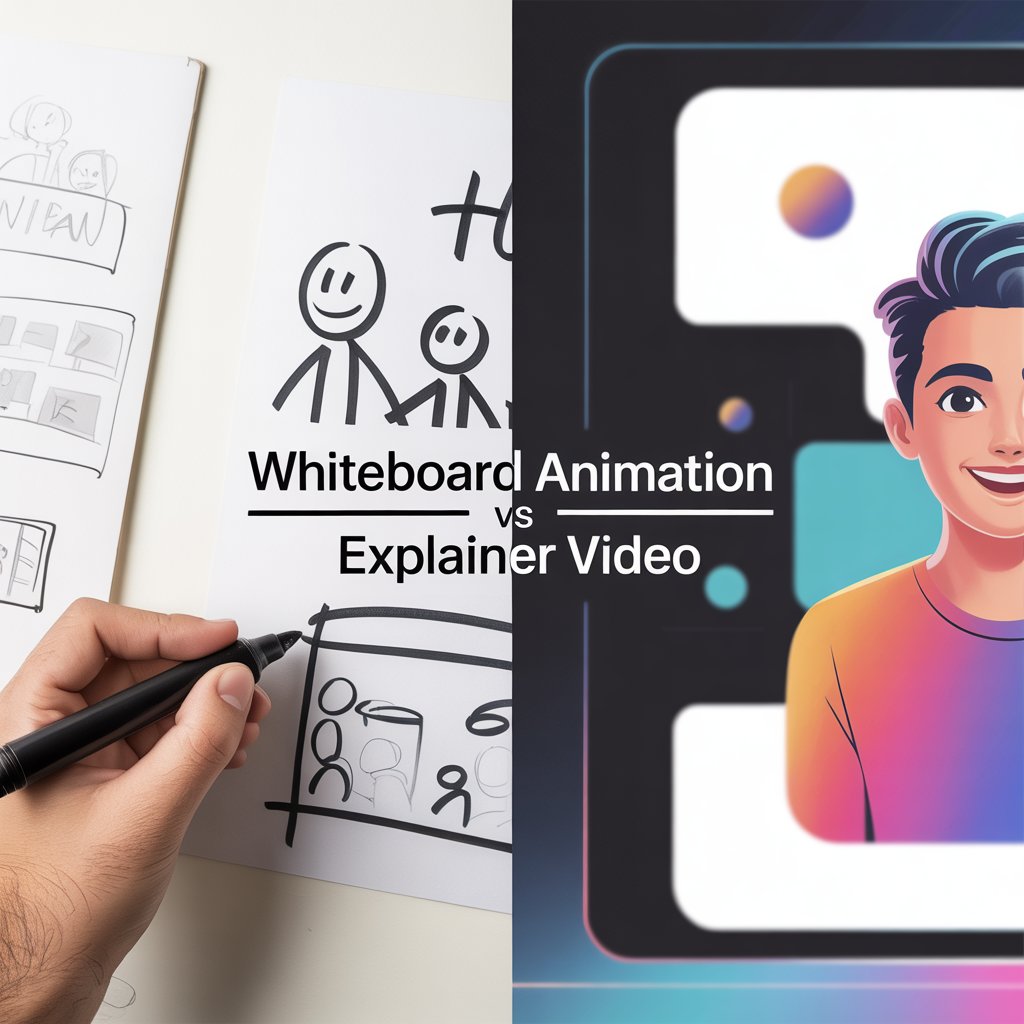
Whiteboard animation is a video style where illustrations appear to build on screen progressively, as if someone is drawing them right in front of you. A hand — sometimes real, sometimes animated — holds a marker and sketches out images, diagrams, and text in sync with a voiceover. The background stays white or near-white. The focus sits entirely on the drawing itself.
That is the whole format. No hidden complexity, no secret sauce. The power is in the mechanic.
How does whiteboard animation work on a production level? The process starts with a script. From there, an illustrator draws every element that will appear on screen — characters, icons, diagrams, labels, everything. Those drawings get animated with a reveal effect timed to match the voiceover, so it looks like a hand is sketching them in real time. A professional voiceover artist records the narration. Everything gets layered together and mixed.
How are whiteboard videos made at a serious studio versus a DIY tool? The difference shows in the illustration quality. Budget tools use pre-made clip art assets that every other video on the platform also uses. Professional whiteboard animation video services build custom artwork specific to your brand, your message, and your audience. That gap is visible on screen in the first ten seconds.
The reason the format works is psychological. When something is being drawn in front of you, you want to watch it get finished. Your brain treats an incomplete drawing as an open loop — and it stays engaged until that loop closes. That sustained attention is what makes whiteboard animation video so effective for explaining complex topics that would otherwise cause viewers to check out.
What Is an Animated Explainer Video?
Here is where a lot of people get tripped up on the explainer video vs whiteboard animation question.
An animated explainer video is not a specific style. It is a category. Whiteboard animation is technically a type of explainer video. But when most people say “explainer video,” they mean something distinct: a full-color, character-driven animated video — usually 60 to 90 seconds long — that tells the story of a product, service, or idea using motion, music, and narrative.
Think of the classic startup homepage video. A frustrated character has a problem. Your product shows up. Problem solved. The character smiles. Brand colors fill the screen. That is an animated explainer video.
The types of explainer videos that fall under this umbrella include:
- 2D animation — illustrated characters in flat or stylized environments, full brand colors, fluid motion and expression
- Motion graphics — text-driven, data-forward, kinetic design without characters
- Character animation — story-driven with recurring brand personas
- 3D animation — dimensional rendering, product showcases, architectural or medical visualization
- Screen capture with animation overlay — common for SaaS explainer videos showing actual software UI
- Whiteboard animation — the style covered above, technically a subset of the broader category
How to make explainer videos that get results comes down to one thing more than production quality: knowing what you want the viewer to do when the video ends. That goal should shape every creative decision — the style, the script length, the character design, the call to action. Studios that skip that conversation and jump straight into design are the ones that deliver videos their clients do not know how to use.
The Real Difference Between Whiteboard Animation and Explainer Video
The difference between whiteboard animation and explainer video is not about quality. It is about what each format is designed to do.
Whiteboard animation is built for clarity. The stripped-down environment removes every visual distraction and puts 100% of the viewer’s attention on the information being communicated. No competing colors, no character expressions to read, no environmental storytelling. Just the concept, drawn out in front of you, piece by piece.
Full animated explainer video is built for feeling. The color, the characters, the motion, the music — all of it works together to create an emotional reaction. You do not just understand the product. You feel something about it. And feeling something is what drives people to click a button.
Neither format is objectively superior. They are different tools for different jobs. The mistake most businesses make is choosing based on what looks impressive in a portfolio rather than what their specific audience needs from that specific video.
Whiteboard Animation vs Explainer Video: The 2026 Head-to-Head
Let us go category by category and actually compare these two formats with specifics — not generalizations.
Viewer Engagement and Attention
Whiteboard animation’s draw-reveal mechanism keeps viewers watching longer on average than static or slide-based content. The progressive build creates genuine suspense — you stay because you want to see what comes next. For longer content (two minutes or more), whiteboard tends to hold attention more consistently than full animation because there is always active movement happening on screen.
Full animated explainer video wins on first impressions. The combination of color, character expression, and music creates an emotional hook in the first five seconds that whiteboard animation — by design — cannot match. For social media video content where you have about three seconds to stop a scroll, a vibrant animated explainer usually outperforms.
Whiteboard animation wins: sustained attention, longer-form content, educational contexts
Animated explainer wins: emotional hook, first impression, scroll-stopping social platforms
Brand Storytelling and Visual Identity
If your brand has a design system — colors, typography, character style, a visual personality — a full animated explainer video lets you extend all of that into motion. Every frame reinforces your identity. Viewers associate the positive emotional response from the video directly with your brand’s specific look and feel.
Whiteboard animation is largely format-neutral. It communicates competence and clarity, but it does not do much to reinforce a unique visual brand. Two whiteboard videos from competing companies in the same industry can look nearly identical when both use similar illustration styles.
For brand storytelling and brand awareness video campaigns, full animation has a clear edge. Visual storytelling that leaves viewers with a specific brand impression requires the full palette that whiteboard deliberately strips away.
Winner: Animated explainer video
Explaining Complex Ideas
This is whiteboard’s home turf. When you have a multi-step process, a technical concept, a regulatory framework, or a software workflow that needs to be communicated clearly — whiteboard explainer videos do that better than almost anything else. Complex ideas simplified is what the format was built for from the beginning.
The reason goes back to the drawing mechanic. When an illustration builds piece by piece in sync with narration, it gives the viewer’s brain time to process each element before the next one arrives. Full animation moves faster and covers more emotional ground, but it can overwhelm when the topic genuinely requires careful step-by-step comprehension.
Winner: Whiteboard animation
Production Cost and Timeline
Whiteboard animation video production costs less and takes less calendar time than full-color animated explainer video at comparable quality levels. The reasons are real and practical:
Custom illustration for whiteboard animation is faster than building fully colored character rigs and background environments. Revisions are simpler because the visual scope is narrower. Production pipelines for whiteboard are more efficient and well-established.
A professional whiteboard animation video for a 90-second piece runs roughly $1,500 to $8,000, depending on illustration depth, customization level, and voiceover quality.
A full 2D animated explainer video at comparable length runs from $3,000 to $20,000 or more at experienced US studios.
That said, cheap whiteboard animation is not actually cheaper in any meaningful sense. A video using generic stock hands and templated clip art signals exactly what it cost — and that signal reaches your audience clearly. Work with whiteboard animation services that hand-illustrate custom artwork for each project.
Winner: Whiteboard animation (for budget-conscious teams)
Conversion on Landing Pages
A landing page video has one job: move cold traffic toward a conversion action. Both formats can accomplish that. The question is which one does it better for your specific audience type.
For B2B landing pages targeting analytical buyers — software engineers, finance teams, healthcare administrators, legal professionals — whiteboard animation tends to build credibility faster. The format signals that you understand their problem at a technical level and are not trying to sell them with flash.
For B2C or consumer-facing SaaS products targeting emotional buyers, a conversion-focused video in full animated style typically wins because it sells the feeling of the outcome rather than just the mechanics of how the product works.
Winner: Depends on buyer psychology — analytical buyers respond to whiteboard, emotional buyers respond to full animation
SEO and Video Marketing Performance
Both formats perform well in video marketing when fundamentals are in place — optimized titles, transcripts uploaded, strong thumbnails, proper platform-native distribution. But there are consistent patterns worth knowing.
Whiteboard animation videos perform steadily on YouTube for informational and educational searches. Someone searching “how does HIPAA compliance work” or “what is a convertible note” is looking for a clear explanation. A well-produced whiteboard explainer is exactly what that search intent expects to find.
Full animated explainer videos tend to outperform on paid social — Meta ads, TikTok, YouTube pre-roll — where emotional engagement and visual stopping power matter far more than educational depth.
For customer education video campaigns: whiteboard.
For animated marketing video running on social platforms: full animation.
How to Make a Whiteboard Animation Explainer Video: What Actually Goes Into It
Many businesses commission a whiteboard animation explainer video without understanding what the production actually involves — which leads to bad briefs, frustrating revision cycles, and results that fall short of what was possible. Here is what the process looks like when it is done properly.
Script writing is where everything starts and where most projects get derailed when they skip proper attention. A solid whiteboard script runs tightly — usually 130 to 150 words per finished minute of video. Every sentence has to earn its spot because the narration is the entire structural backbone the visual sequence hangs on. Padding in the script turns into dead weight in the finished video.
Storyboard development translates the script into a visual sequence. The storyboard maps which illustrations appear at which moments, how scenes transition, and what the reveal order of each drawn element looks like. In a professional production, this is a collaborative checkpoint — the client sees the visual logic before any final asset gets illustrated. Catching problems at storyboard stage costs a fraction of what it costs to fix them in animation.
Illustration and asset creation is the most labor-intensive part of the pipeline. Every element that appears on screen — every character, diagram, icon, label, environmental detail — gets custom illustrated. This is precisely where professional whiteboard animation video services separate themselves from template-based tools. The quality of the illustration determines how the finished video lands with real audiences.
Animation and timing applies the draw reveal effect and synchronizes each illustrated element to the voiceover track. Transitions between scenes, pacing adjustments, and secondary motion details get finalized at this stage.
Voiceover recording uses a professional narrator matched to the tone of the content and the expectations of the target audience. For US-market videos specifically, decisions about pacing, energy level, and regional authenticity matter more than most clients expect. A mismatched voiceover undermines great illustration.
Final audio mix and delivery brings everything together — voiceover, background music, and any audio design elements — into the finished piece. The video gets exported in the formats required for its intended distribution platforms.
At Drawphics, every stage of that pipeline runs in-house, which means no handoff gaps and no version inconsistency between stages.
Whiteboard Animation for Business: Where It Actually Fits in 2026
Whiteboard animation for business has not lost ground in 2026 despite the growth of full-color animation tools and platforms. The oversaturation of cheap 2D animation has, if anything, made well-crafted whiteboard content more distinctive — not less. When every competitor is running the same character animation template, a thoughtfully produced whiteboard video stands out for its intentionality.
Where whiteboard animation consistently delivers for US businesses right now:
SaaS explainer video for user onboarding — Users who just signed up need to understand how to use your product. They do not need to be sold on it. Whiteboard animation walks them through processes step by step without the emotional selling layer that is both irrelevant and potentially irritating at the post-signup stage.
Corporate explainer video for internal use — Training content, compliance videos, policy explanations, process documentation. The educational register of whiteboard fits these contexts in a way that character-driven animation often does not.
Educational animation for nonprofits and healthcare — The format reads clearly across age groups, education levels, and cultural backgrounds, making it particularly strong for organizations that serve genuinely diverse US audience segments.
Startup explainer video on a constrained budget — For early-stage companies that need strong video content before they have a mature brand identity, whiteboard animation lets the message carry the video without requiring a complete design system behind it.
The animation services at Drawphics include whiteboard production built specifically for these use cases — with custom illustration, not template shortcuts.
Explainer Video for Business: When Full Animation Earns Its Cost
The case for investing in a full explainer video for business is strongest when you are building something designed to outlast a single campaign cycle.
Product explainer video for a new launch — You have one chance to introduce something new to your market. A high-production animated explainer communicates that the product is serious, the brand is serious, and you are asking for serious consideration in return. Whiteboard does not send that signal in the same way.
Brand awareness video campaigns — For video marketing initiatives running across YouTube, Instagram, and LinkedIn, the visual richness of full animated marketing video makes your brand memorable in a crowded feed in ways that stripped-back whiteboard content is not designed to accomplish.
Investor-facing startup explainer video — When you are presenting to investors, production quality is a proxy signal for execution quality. A polished animated explainer communicates that you know how to allocate resources and deliver — which matters as much as what the video actually says.
Sales video for high-ticket B2B — Enterprise sales cycles are long. A well-produced animated explainer video that a sales rep sends after a discovery call keeps your solution visible and credible during the evaluation period in a way that text follow-ups cannot match.
Check out our explainer video production service to see what full-production animated content looks like when it is built around real business goals rather than template aesthetics.
2D Explainer Video vs Whiteboard Animation: When the Choice Comes Down to Style
The 2D explainer video vs whiteboard animation comparison comes up most often for software companies, healthcare brands, and education platforms — industries where the content is substantive and the audience is discerning.
2D animation gives you characters that walk, talk, gesture, and emote inside fully realized color environments. The visual world you build belongs specifically to your brand — aesthetically considered, emotionally expressive, and reinforcing of your identity every time someone watches. It takes longer and costs more than whiteboard, but the payoff is a video that feels like it belongs to your brand rather than to the format.
Whiteboard animation gives you a clean instructional canvas. The trade-off is deliberate: you get stronger information delivery and lower production cost in exchange for less emotional range and less brand-specific visual personality.
For a product demo video that needs to show your software interface functioning, 2D animation with motion graphics layered onto screen recordings typically outperforms whiteboard. Demonstrating a product in action is visual work that whiteboard’s format is not optimized for.
For a customer education video explaining how your product category works — the problem it solves, the workflow it replaces, the outcome it creates — whiteboard animation is a strong choice because comprehension is the only goal, and whiteboard serves comprehension better than any other format.
Both styles are represented in our portfolio — take a look at the production difference in context.
Which Is Better — Whiteboard Animation or Explainer Video?
Which is better whiteboard animation or explainer video is genuinely the wrong question to be asking. The right question is: what does this specific video need to accomplish, and which format is actually built for that job?
Here is a decision table that skips the hedging:
| What You Need the Video to Do | Format to Use |
| Explain a technical or multi-step process | Whiteboard animation |
| Launch a product with emotional impact | Animated explainer video |
| Train employees on internal processes | Whiteboard animation |
| Stop the scroll on social media | Animated explainer video |
| Onboard SaaS users post-signup | Whiteboard animation |
| Support enterprise B2B sales conversations | Animated explainer video |
| Communicate complex ideas to analytical audiences | Whiteboard animation |
| Build emotional brand recognition at scale | Animated explainer video |
| Operate with a limited production budget | Whiteboard animation |
| Reinforce a mature visual brand identity | Animated explainer video |
The best explainer video style for your project comes down to four inputs: your goal, your audience type, your brand maturity, and your budget. Get those four inputs right and the format decision becomes straightforward. Most businesses that make the wrong choice skipped one of those four.
Whiteboard Animation Benefits That Hold Up in 2026
Whiteboard animation benefits that remain durable regardless of where the trend cycle is pointing:
The format forces clarity. You cannot hide a weak explanation behind pretty character animation when the entire video is built on line drawing and narration. If your message is not clear in whiteboard format, it is not actually clear. Many brands discover this when they try to produce a whiteboard script — and find their messaging needs more work than they expected.
It reads as authoritative without being cold. Across US audience segments, the whiteboard visual style triggers associations with education, expertise, and teaching. That positioning is valuable for brands establishing themselves as credible voices in their category.
Production is more revisable. Because the format is simpler visually, content changes late in production are more manageable than they would be in full-character animation. For brands in regulated industries where legal or compliance review can alter messaging at the last minute, this practical flexibility matters.
It does not date quickly. A whiteboard animation video from three years ago still looks intentional because it was never chasing a visual trend. Full-color animated styles shift with design fashions, and videos from five years back often look visibly dated. Whiteboard avoids that trap by staying format-first rather than trend-first.
Explainer Video Benefits That Justify the Investment
Explainer video benefits that make the cost worth it when the context is right:
Emotional memory outlasts informational memory. People who watch a character-driven animated explainer video remember how the brand made them feel long after they forget the specific features that were mentioned. In competitive markets where product differentiation is narrow, brand feeling is often what actually drives the purchase decision.
The visual storytelling range is genuinely broader. Full animation lets you show before-and-after transformations, aspirational outcomes, character journeys, and environmental context in ways whiteboard cannot attempt. For consumer brands, that narrative range is not a luxury — it is the whole game.
A well-made animated marketing video is reusable across multiple contexts for years. Homepage hero video, trade show display loop, YouTube pre-roll ad, sales deck embed, email campaign — one quality production can serve all of those use cases. The per-use cost drops significantly over time, which is a real argument against treating it as expensive relative to whiteboard.
Quality signals seriousness. For premium-priced products and services, a high-production animated explainer tells prospects that you take your brand seriously — which makes it easier for them to take you seriously in return. In a market full of cheap template videos, production quality is a genuine differentiator.
Why Drawphics for Your Next Animation Project
Drawphics is a creative animation studio that works with US-based businesses across the full range of video formats — from tightly focused whiteboard animation video services to full-production animated explainer campaigns built to carry brands for years.
What is different here from template-based production shops:
Every whiteboard animation project starts with custom illustration — not stock hands, not recycled clip art, not assets pulled from the same library three other clients used last month. The artwork is drawn specifically for your brand, your message, and the audience you are trying to reach.
Every explainer video project goes through a script consultation before a storyboard is opened. The story has to work on paper before it gets built in motion. Skipping that step is exactly how studios end up delivering expensive videos that do not say what the client needed them to say.
The full animation services offering covers 2D animation, 3D animation, whiteboard animation, AI animation, character rigging, and explainer video production — all under one roof. No handoffs between vendors at different stages. No version inconsistency. No gaps in communication.
Beyond animation, Drawphics also provides graphic design services and illustration services — so your visual identity stays consistent whether it is moving or standing still. See what our artists and what we do pages have to say about the team behind the work.
Browse theportfolio to see the quality across formats. Then contact the team and tell us what you are trying to accomplish — that is always the right place to start.
Frequently Asked Questions
Q1: What is the main difference between whiteboard animation and an animated explainer video?
Whiteboard builds illustrations progressively on a plain background — a clarity-first format built for information delivery. An animated explainer video uses full color, characters, and motion to create emotional engagement and reinforce brand identity.
Q2: Which format works better for a SaaS explainer video?
Whiteboard suits onboarding and concept-heavy education. Full 2D animation fits product launches and top-of-funnel brand awareness. Many SaaS brands use both formats at different stages of the customer journey.
Q3: How much does whiteboard animation cost compared to a full animated explainer video?
Professional whiteboard runs $1,500–$8,000 for 60–90 seconds. Full 2D animated explainer production typically costs $3,000–$20,000+ at the same length, depending on character complexity, environment detail, and studio experience level.
Q4: How long does it take to produce a whiteboard animation video?
A professionally produced whiteboard animation video typically takes 3–6 weeks from approved script to final delivery, accounting for illustration, animation, voiceover recording, and revision rounds.
Q5: Can whiteboard and full animation styles be combined in one video?
Yes — hybrid videos blending whiteboard sketch sequences with color animation or motion graphics are increasingly common. They combine whiteboard’s instructional clarity with full animation’s emotional range effectively in a single piece.
Need animation built for real results? Explore Drawphics Animation Services or reach out directly to talk through your specific project goals.