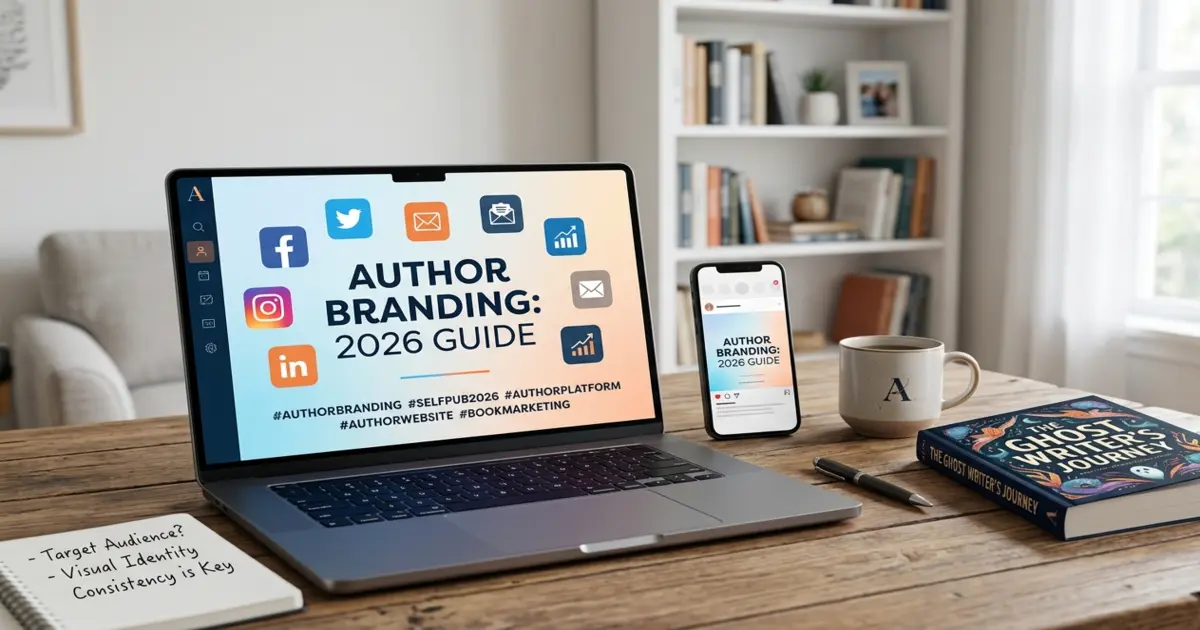
Author branding 2026 is one of those phrases that sounds like marketing fluff until you watch two authors release almost identical books, in the same genre, on the same day — and one of them outsells the other three to one. Nine times out of ten, that gap isn’t the writing. It’s that one author was recognizable before the launch even started, and the other was a stranger asking for a sale.
I’ve had this conversation with a lot of indie authors, and it usually goes the same way. Branding gets treated as the thing you’ll “figure out eventually,” somewhere after the manuscript’s done, after the cover’s picked, after the launch date’s already locked in. By the time it gets attention, it’s a patch job stitched on at the last minute rather than something built with any real plan behind it. This self-publishing guide is meant to fix that order. We’ll get into what author branding actually looks like this year, why the old approach from a few years back doesn’t cut it anymore, and how to put something together that readers can actually recognize — without needing a marketing team on payroll.
What Author Branding Actually Means in 2026
A few years ago, author branding basically meant a decent headshot and a bio that didn’t have typos in it. That’s not where the bar sits anymore. Readers are scrolling faster than ever, and they’re weighing your book against a wall of other authors writing in the exact same lane, sometimes the exact same trope. Your brand is what gives someone a “you’ll like this” feeling before they’ve read a single line of your blurb.
That feeling comes from a handful of pieces working together — your covers, your website, how you show up on social, the tone of your captions and newsletters, even the colors that keep showing up wherever readers find you. None of it has to be flashy, honestly. It just has to feel like the same person every time. That’s really the whole definition of branding for independent authors in 2026. Not logos. Not a clever tagline. Just being recognizable.
How to Build an Author Brand From Scratch
If you’re starting from zero, don’t try to knock all of this out over one weekend. It doesn’t work that way, and rushing it usually means redoing half of it in six months anyway.
Step 1: Define Your Author Platform
Your author platform is everything a reader could point to and say “yep, that’s them.” Website, social accounts, your email list, even how you come across in a podcast interview if you ever land one. Before touching any design work, sit down and write out three things: your genre, the emotional promise your books make to readers, and the type of person who’d actually recommend you to a friend. Everything else you build gets stacked on top of that.
Step 2: How to Brand Yourself as a Fiction Writer
Branding fiction is harder than branding nonfiction because you’re not selling expertise — you’re selling a mood. A cozy mystery writer and a grimdark fantasy writer shouldn’t look or sound anything alike online, even though technically they’re both “just” novelists. Pick three words that capture the feel of your writing. Moody. Playful. Brutal. Whatever actually fits. Then run every graphic, every caption, every design choice through that filter before it goes live. If something doesn’t match the mood, it’s off-brand, even if it happens to look nice sitting on its own.
Step 3: Author Website Design That Actually Converts
Your website is the one corner of your platform you fully own, no algorithm involved. Instagram can change its rules tomorrow; your site answers to nobody but you. Good author website design in 2026 needs to load fast, work on a phone screen without breaking, and push a visitor toward one of three things within a few seconds — buying the book, joining the newsletter, or reading the first chapter. Save the long “my writing journey” story for the About page. Nobody’s reading that on the homepage before they’ve even decided if they like your covers.
Step 4: Social Media for Authors, Without Burning Out
You do not need to be everywhere. Pick one platform where your actual readers already hang out, and show up there consistently instead of spreading thin across five. Social media for authors works best as a rhythm — cover reveals, little behind-the-scenes writing moments, character art, the occasional quote pulled from the book — rather than posting whatever crosses your mind whenever inspiration strikes at 11pm. Batch a month’s worth of content in one sitting if you can. It keeps you consistent without eating into the time you’d rather spend actually writing.
Branding for Independent Authors: Book Covers and Visual Identity
Here’s something most self-publishing guides skip right past: your book cover is your brand, more than any logo you’ll ever design. It’s the first visual thing a reader sees, and if it doesn’t match what your genre trains people to expect, no clever blurb is saving that sale afterward.
This is where a dedicated book cover design team earns its keep, especially once you’ve got more than one title out. A series needs covers that read like siblings — same font logic, same color language, same illustration approach — so a reader who loved book one spots book two immediately without having to squint at your name. If your genre leans illustrated or stylized, going with illustrator book cover design tends to hold up better as a tiny retail thumbnail than a photo-based cover would, and that matters a lot in fantasy, YA, and romance specifically.
Past the cover itself, your visual identity should stretch into your social graphics, your website banners, your newsletter headers, all of it. A real graphics branding pass ties your palette, fonts, and icon style together so nothing you post ever looks like it wandered in from a completely different author’s account. And if you’re active on Instagram or TikTok, having social media content graphics built off your brand kit saves a genuinely surprising amount of time compared to designing every single post from a blank canvas.
Book Marketing Strategy and Book Launch Template Basics
A nice brand with no launch plan behind it is just a good-looking website nobody visits on release day. A real book marketing strategy usually starts eight to twelve weeks out from publication — not the week the book actually drops.
Roughly, a book launch template breaks down like this:
- 8 weeks out: cover reveal across social and newsletter, ARC copies out to early readers
- 4 weeks out: preorder link goes live, first reviews start trickling in from that ARC group
- 2 weeks out: countdown posts, excerpt teasers, maybe an author interview or podcast guest slot
- Launch week: daily posts, a newsletter blast, and a direct ask for readers to leave reviews within the first 48 hours
- One week after: a thank-you post, a roundup of early reviews, and outreach to reader groups and bookstagram accounts
None of it holds together if your branding shifts from one touchpoint to the next. If a reader sees your countdown graphic on Instagram, they should see that same visual language on your Amazon page and in your newsletter without having to work at recognizing it.
When Should an Author Start Branding?
Honestly? Before the first draft is even finished. Author branding 2026 works best when it grows up alongside the book instead of getting bolted on after the fact. Waiting until launch week means you’re trying to build trust and close a sale at the exact same moment, which is a much steeper climb than showing up consistently for months beforehand.
That said, it’s genuinely never too late to start. Plenty of authors end up rebranding somewhere between book two and book three, once they actually understand their genre and their readers better than they did on day one. If your current brand doesn’t match what you’re writing now, a refresh mid-career is completely normal — nobody’s going to hold that against you.
Do Self-Published Authors Need a Logo?
Not really, and this is where a lot of new authors get stuck spending money they didn’t need to spend. A logo makes sense if you’re building out a publishing imprint or some kind of multi-book brand identity that goes beyond just your own name. Most fiction authors, though, are better off with a strong signature — a consistent way your name is styled in one specific font and color — rather than an actual logo mark. Readers remember names and covers far more reliably than they remember icons.
How Much Does It Cost to Build an Author Brand?
This one really depends on how much you’re doing yourself versus handing off. A DIY route using templates can land under $100 total, once you’ve paid for fonts, a few stock elements, and a basic website theme. Bringing in professionals for the full package — book cover design, a matching website, a social media kit — usually runs somewhere between a few hundred dollars and a couple thousand, depending on how many touchpoints you need covered and how polished you want each one to be. The payoff tends to show up later, in better click-through rates on ads and readers who stick around across a whole series, so it’s worth thinking of as an investment rather than a one-time expense you’re just trying to minimize.
Indie Author Tips to Keep Branding Consistent
A few habits tend to separate authors whose branding actually holds up from the ones whose branding quietly falls apart after a few months:
- Keep a simple brand sheet somewhere with your exact color codes, fonts, and cover style notes, so any future graphic matches without guesswork
- Reuse the same author photo and bio wording everywhere instead of rewriting it fresh for every platform
- Revisit your brand every year or two, especially if you’ve drifted into a different subgenre than where you started
- Skip chasing every new design trend — consistency wins over novelty when the whole point is being recognized
- Make sure your newsletter, your website, and your social bios are all telling the same story about who you are and what you write
Final Thoughts
Author branding 2026 really comes down to one test: could a reader spot your book, your post, or your website and know it’s yours without needing to see your name attached? If the honest answer is no right now, that’s fine. Most authors get there gradually, book by book, not in one big overnight push. Start with your covers and your website first, since those two carry the most weight, and build outward from there once those feel solid.
If you’d rather not piece all of this together on your own, our team can help with everything from book cover design to full graphics branding kits built specifically for self-published authors. Take a look at our portfolio or contact us and let’s talk through what your brand actually needs right now.
Frequently Asked Questions
1. What is author branding in 2026?
It’s the consistent look, voice, and feel across your covers, website, and social media that lets readers recognize you instantly, book after book.
2. When should an author start branding?
Ideally before your first book launches, so your platform builds trust alongside your writing instead of scrambling to catch up at release.
3. Do self-published authors need a logo?
Not always. A styled author name signature usually works better than a logo unless you’re building a multi-book imprint identity.
4. How much does author branding cost?
DIY branding can cost under $100. Professional cover design, website, and social kits typically range from a few hundred to a couple thousand dollars.
5. How do I brand myself as a fiction writer?
Pick three mood words matching your genre, then keep your covers, colors, and captions consistent with that feeling across every platform you use.