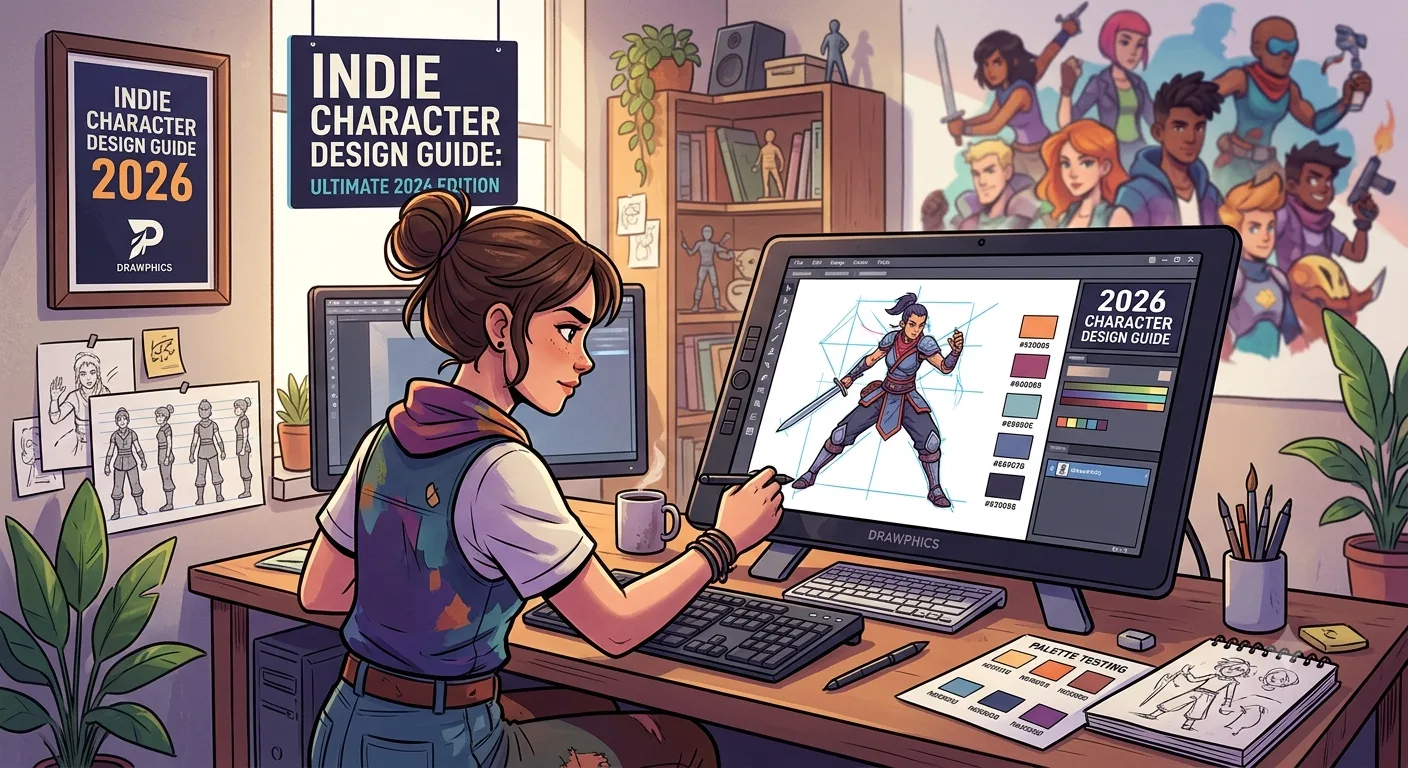
If you’ve typed “indie character design guide 2026” into Google more than once this month, you’re probably stuck somewhere between a blank canvas and a deadline. That’s normal. Every indie artist and solo game developer hits the same wall: you know your character needs personality, but turning that idea into a design that actually reads on screen (or on a book cover) is a different skill altogether.
This guide breaks down the real, working process behind indie character design — the one used by working illustrators, not just theory from an art school lecture. By the end, you’ll have a repeatable character design workflow you can use for your next game, comic, or story project.
What Indie Character Design Actually Means
Indie character design is the process of building a character’s look, personality, and visual identity without the budget or team size of a big studio. That limitation isn’t a weakness — it forces smarter decisions. When you don’t have twenty artists on payroll, every line, color, and silhouette choice has to earn its place.
This is exactly why an indie character design guide matters more in 2026 than it did five years ago. Tools have changed, audiences have changed, and the bar for “good enough” character art has quietly gone up. Players and readers can tell the difference between a character that was designed with intention and one that was rushed.
Why This Character Design Guide 2026 Approach Works
Most character design tutorials online focus on drawing tips — how to shade a face, how to render fabric. Those things matter, but they’re not where indie projects usually fail. Indie characters fail at the concept stage, long before a single line is drawn well or badly.
A solid character design workflow answers these questions first:
- Who is this character to the story or game?
- What single silhouette or color choice makes them instantly recognizable?
- Will this design still work small — on a thumbnail, an app icon, or a mobile screen?
Get those three right, and the drawing part becomes much easier.
Step 1: Start With Story, Not With a Face
Before opening any drawing app, write two or three sentences about who this character is. Not their backstory — their function. Are they comic relief? A silent protector? A morally grey antagonist? This single step separates amateur character concept art from work that actually holds up.
Indie artist character design tips almost always circle back to this point: design decisions made without a clear character role tend to look generic, no matter how technically clean the linework is.
Step 2: Build a Repeatable Character Design Workflow
Here’s a 2D character design process that scales whether you’re designing one hero or an entire cast:
- Thumbnail silhouettes — five to ten tiny, quick shapes exploring body type and pose, no details.
- Silhouette selection — pick the one readable as a shape alone, in solid black.
- Feature pass — add face, hair, and costume shapes on top of the chosen silhouette.
- Color exploration — test two or three palettes before committing.
- Cleanup and final line art — only now do you polish details.
- Reference sheet — turn the final design into a usable production document.
Skipping straight to step six is the single most common mistake in indie character design, and it’s usually why revisions take three times longer than they should.
Step 3: Why Reference Sheets for Character Design Are Non-Negotiable
A reference sheet (sometimes called a model sheet or turnaround) isn’t just for animation studios. Even a solo comic artist or indie developer needs one, because:
- It keeps proportions consistent across dozens of panels or in-game scenes.
- It documents exact colors (hex codes, not “kind of blue”).
- It saves you from redrawing the same character slightly differently every time.
A minimum reference sheet includes a front view, a side view, a color-flat version, and a few key expressions. If you’re working with an outside artist or team, this document is what keeps everyone aligned — it’s also exactly the kind of deliverable a professional character design service provides as part of a full character package.
Step 4: Character Design Anatomy Basics You Can’t Skip
You don’t need to master full figure anatomy to design good characters, but a few anatomy basics prevent designs from falling apart:
- Proportion consistency — decide on a head-to-body ratio and stick to it across the whole cast.
- Weight and balance — a standing pose should look like it could actually stand.
- Readable joints — shoulders, elbows, and knees need to bend in ways that make sense for the pose you’re drawing.
- Exaggeration with logic — stylized characters can bend anatomy rules, but the exaggeration should still feel intentional, not accidental.
Stylization is a choice. Anatomical confusion is a mistake. Knowing the difference is what separates a professional-looking indie character from an amateur one.
Step 5: Picking Character Color Palettes 2026 Style
Color trends shift, but the underlying rule doesn’t: a character should be identifiable by silhouette and color alone, even in low light or from a distance. For character color palettes 2026 audiences respond well to:
- Two dominant colors plus one accent color, rather than five competing tones.
- Warmer, higher-contrast palettes for protagonists; muted or cooler tones for background or supporting characters.
- Palette testing against the actual background your character will appear on — a game level, a book page, or a social post.
If two characters in the same story share a palette, players and readers genuinely struggle to tell them apart. Test your full cast side by side before finalizing anything.
Step 6: Budget Character Design Tools Worth Using
You don’t need an expensive software stack to produce professional results. Budget character design tools that indie creators rely on include free and low-cost drawing apps with layer support, basic vector programs for clean line art, and simple palette-generator tools for quick color testing. What matters far more than the software is the workflow behind it — a strong process on a free tool will always beat a weak process on an expensive one.
Step 7: Unique Character Design Ideas That Don’t Feel Recycled
Reviewers and players notice when a character feels like a reskin of something they’ve already seen. A few ways to push toward more unique character design ideas:
- Combine two unrelated references (a job, an era, an animal) instead of one obvious inspiration.
- Design the accessory first, then build the character around it.
- Ask what a “normal” version of this archetype would look like — then change one major thing.
Originality in indie character design rarely comes from a completely new idea. It comes from an unexpected combination of familiar ones.
Indie Game Character Design: What’s Different
Indie game character design has extra constraints a book or comic character doesn’t. Characters need to read clearly in motion, at small sizes, and sometimes from multiple camera angles. Silhouette clarity matters even more here, and so does keeping the color count low enough that the character doesn’t blend into busy game backgrounds. If your game has combat, expressions and poses also need to communicate state (health, aggression, calm) at a glance — something worth testing early with rough sprites before committing to final art.
Character Concept Art Tutorial: Quick Recap
If you only remember one thing from this character concept art tutorial, make it this: concept art exists to answer questions, not to look pretty. Every sketch should be testing something — a silhouette, a color, a prop placement. Concept art that “looks finished” too early usually locks in bad decisions before they’ve been properly tested.
Common Mistakes Indie Artists Make (And How to Avoid Them)
- Designing in full color from sketch one — locks you into decisions too early.
- Ignoring how the character reads at small size — a huge problem for game icons and thumbnails.
- No reference sheet — leads to inconsistency across a project.
- Copying instead of referencing — always combine multiple influences, never trace one.
- Overdesigning — too many colors, patterns, or accessories usually weaken a character rather than strengthen it.
When It’s Time to Bring In a Professional
This indie character design guide 2026 approach works well for solo projects and early prototypes. But there’s a point in most indie projects — a Kickstarter, a Steam page, a published comic — where the art needs to hit a professional bar fast, and doing it all solo isn’t realistic anymore.
That’s usually when indie teams bring in outside help for full illustrator services, whether that’s character design specifically, comic pages, 2D illustration, or digital concept art for a broader visual world. You can browse examples of finished character work in the Drawphics portfolio, or learn more about the studio on the About Us page.
Final Thoughts
Good indie character design isn’t about talent you either have or don’t — it’s a process. Start with story, build a repeatable workflow, document everything in a reference sheet, and test your color and silhouette choices before committing. Follow this indie character design guide 2026 approach consistently, and your characters will start looking like they belong in a finished, professional project — because they will be.
If you’d rather hand the character work to a team that does this daily, you can contact Drawphics to discuss your project.
FAQs
1. What is indie character design?
It’s designing original characters — look, personality, and visual identity — for solo or small-team creative projects, without a big studio’s resources.
2. How do I start designing an indie game character?
Define the character’s story role first, then thumbnail silhouettes before adding any color or detail work.
3. What tools do indie artists use for character design?
Free or low-cost digital drawing apps with layers, plus simple palette tools. Workflow matters more than software price.
4. Why do I need a character reference sheet?
It keeps proportions, colors, and details consistent across every scene, panel, or game asset featuring that character.
5. When should I hire a professional character designer?
When your project needs a polished, consistent cast fast — for a launch, publication, or crowdfunding campaign.