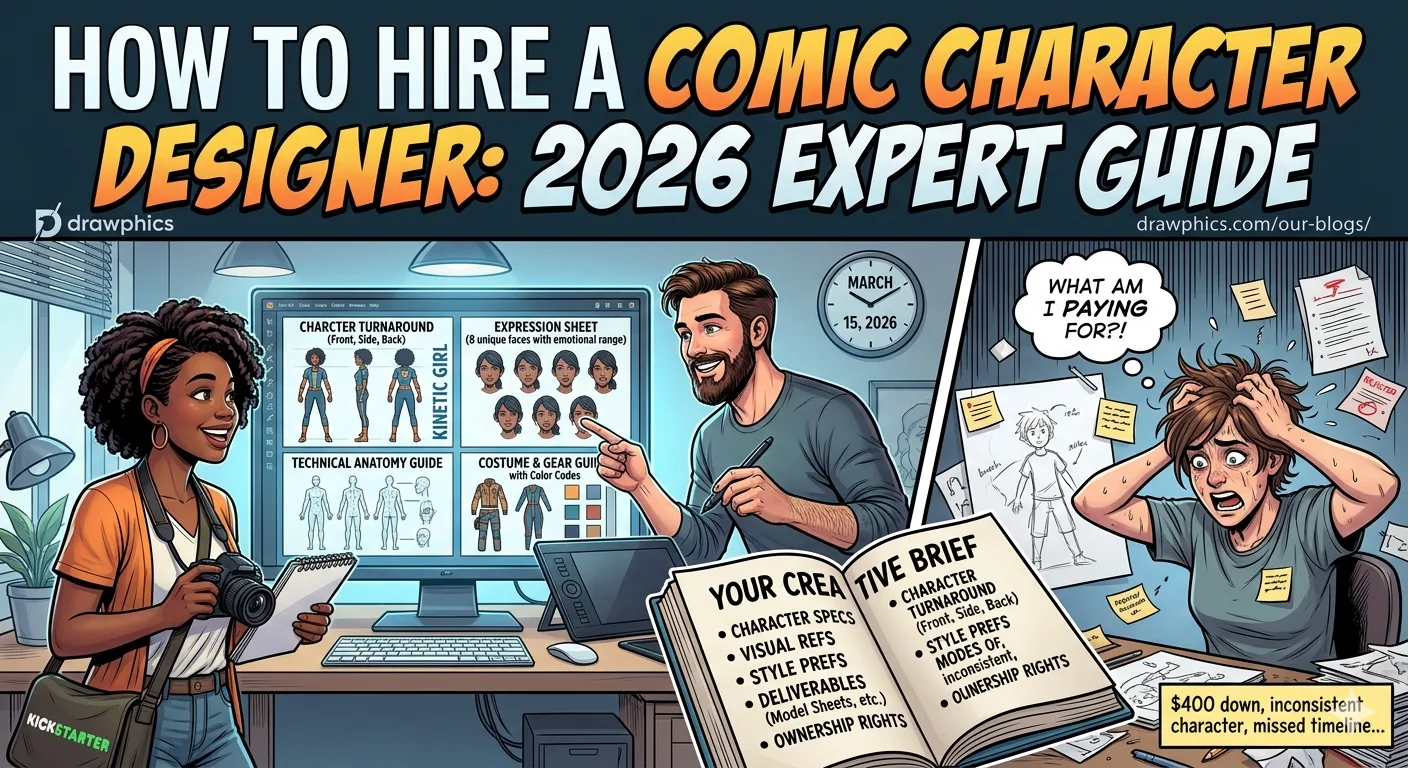
Let me be straight with you. Finding a good comic character designer is one of those things that looks easy until you’re three weeks in, $400 down, and staring at a character who looks nothing like what you described.
I’ve talked to enough indie comic creators across the US to know this problem is way more common than people admit. The search feels simple at first — you Google a few things, find some portfolios, and think you’ve got it figured out. Then the back-and-forth starts. The revisions pile up. The timeline slips. And suddenly the character who was supposed to anchor your whole graphic novel looks like a stranger.
This guide is about skipping that whole mess.
If you’re a comic character designer’s dream client — someone who comes in prepared, knows what to ask, and understands what they’re actually paying for — you’ll get better work, fewer headaches, and a character that actually feels like yours.
What a Comic Character Designer Actually Does (And Why It’s More Than Drawing)
People hear “comic character designer” and picture someone at a tablet sketching a cool-looking person. That’s part of it. But the job is really about documentation — building a visual system around your character that other people can use without losing their mind.
Here’s what you’re actually getting when you hire someone properly:
Character model sheets are the first thing. Front view, side view, back view — all at the same scale, all consistent. The whole point is that if you hand this sheet to three different artists, they all draw the same character. Without it, your main character slowly drifts into being a different person across your pages. It happens more often than you’d think.
Character turnaround is the full 360-degree rotation. This matters especially if you’re working with multiple artists, or if your project is heading toward animation down the line. A character rigging artist will absolutely need this.
Expression sheet is where a lot of cheaper designers cut corners, and where you can immediately tell who knows what they’re doing. A real expression sheet doesn’t just show “happy” and “sad.” It shows the full emotional vocabulary of the character — the specific way this person looks when they’re embarrassed, or suspicious, or trying to hold back tears. That’s visual storytelling doing its job.
Color palette and costume guides round everything out. These are callout sheets that tell future artists or colorists exactly which hex codes and specific colors belong to this character. No guessing, no inconsistency between issues.
When you’re building a graphic novel or a multi-issue comic series, the whole illustration pipeline depends on getting these documents right at the start. Drawphics’ character design service delivers all of this as a package — if you want a benchmark for what production-ready deliverables look like, that’s a good place to start.
Why 2026 Is Actually a Hard Year to Pick Wrong
Indie comics in the USA are having a real moment. Webtoon series are turning into animation deals. Kickstarters for graphic novels are routinely hitting six figures from first-time creators. The barrier to self-publishing has dropped to basically zero.
That sounds great. And it is. But it also means the reader pool has gotten more sophisticated. People consuming indie comics in 2026 are also watching high-production-value animation, reading Marvel and DC, and scrolling through professionally illustrated webcomics every day. They notice when your character looks like a different person between chapters.
Hiring the wrong comic character designer early is the kind of decision that haunts you for the entire life of your project. You’re twelve issues in and your main character has somehow aged, changed bone structure, and lost the distinctive silhouette that was supposed to make her recognizable. Now every new artist you bring on has to figure out who she actually is because the original design docs don’t exist or are inconsistent.
The concept art and foundational design work is where you prevent that. Get it right at the start and everything downstream — every illustrator, every cover artist, every animator — has a clear map to work from. Rush it and you’re patching problems forever.
The 5 Different Types of Comic Character Design Services
Not every comic character designer does the same thing. This matters a lot because hiring the wrong type of designer is just as bad as hiring a bad one.
1. Concept and Ideation Only
This is early-stage work — loose sketches, silhouette explorations, style tests. It’s where you figure out what your character looks like at all. A lot of indie comic creators skip this phase and jump straight to finals, then wonder why the design feels wrong. If you’re not 100% sure what your character looks like yet, this is where you start. It’s usually cheaper than full production work and saves you from expensive redesigns later.
2. Full Production Model Sheets
This is the meat of what most creators need. The character turnaround, expression sheet, color palette, and costume guide — the whole package. Everything another artist needs to draw your character without calling you every five minutes. This is the standard for any serious comic project.
3. Full Cast / World-Building Packages
Some studios, including Drawphics, will take your full script and design every named character in your story. If you’re launching a graphic novel with a large cast, this is how you get visual consistency across an ensemble without going back and forth with five different freelancers who’ve never seen each other’s work.
4. Redesign and Style Adaptation
Maybe you’ve got an existing character from an older webcomic, or a design you originally sketched yourself that needs professional polish. Redesign services take what exists and evolve it — modernize the look, clean up the proportions, adapt it for print or animation — without stripping out the original personality.
5. Animation-Ready Builds
If there’s any chance your comic could become animated — or if you want animated promo content for launches and marketing — you need a designer who builds with animation in mind from the start. That’s a different skillset than standard illustration. The geometry has to work, the joints have to be sensible, and the rig has to actually move. This connects directly into the character rigging phase.
Hiring a Character Designer for Games, Mascots, or Other Non-Comic Projects
Everything above applies whether you’re hiring for a comic, a game, a brand mascot, or an illustrated marketing character — the core process (brief, portfolio review, ownership terms, paid style test) doesn’t change. What shifts is the deliverables:
- Game characters often need 3D-specific work — topology, texture maps, and rigging-ready models — on top of the standard concept and turnaround sheets.
- Brand mascots prioritize a simple, flexible design that reads clearly at small sizes across marketing materials, more than deep narrative detail.
- Pricing shifts too: 3D character work for games commonly runs $1,000–$10,000+, well above standard 2D comic character rates, due to the added modeling and rigging pipeline.
How to Hire a Character Designer: The Real Step-by-Step
Step 1: Write the Creative Brief Before You Do Anything Else
The creative brief is the most underrated part of this whole process. Most bad character design jobs I’ve heard about trace back to a brief that was either too vague, too short, or just not written at all.
A good brief for a comic character designer covers all of this:
- Character name and their role in the story (are they the protagonist? a villain? comic relief?)
- Physical specifics — age range, height, build, skin tone, distinguishing features, anything that’s non-negotiable
- Personality and backstory details that should show up in the design — a character who’s been on the run for three years should look different than one who grew up wealthy and comfortable
- Visual references — other characters, real people, art styles that capture something close to what you’re imagining
- What you want the character to feel like — intimidating, approachable, mysterious, chaotic, gentle
- Art style preference — realistic, manga-influenced, flat graphic, painterly, cartoonish
- Who the audience is and what the overall tone of the project is
- The actual deliverables you need (model sheet, turnaround, expression sheet, color guide — be specific)
Here’s what designers actually say about this: when a client sends a two-sentence brief, they have to fill in all the blanks with their own interpretation. Sometimes that works out. Usually it doesn’t. The brief you write is a direct investment in the accuracy of what comes back to you.
Step 2: Review Portfolios Like Someone Who Knows What They’re Looking At
Browsing portfolios is not the same as evaluating portfolios. Most people look at a portfolio and ask “do I like this art?” That’s the wrong question.
The right questions are:
Is this character the same person across multiple pieces? Consistency is everything in comics. A designer who can paint a stunning single illustration is not necessarily someone who can maintain visual consistency across sixty pages. Look for evidence that they can — the same design, redrawn in different poses, different moods, different contexts, and still unmistakably the same character.
Can I read these characters at thumbnail size? Pull up their work and shrink it down. Does the character still read? Do the silhouettes hold? A character that only works at full resolution is going to disappear inside a comic panel.
What do the expression sheets actually show? If there are expression sheets in the portfolio, look at them hard. Is there real emotional range — subtle expressions, not just four exaggerated faces? Does each expression feel authentic to that character’s personality?
What’s their genre experience? This sounds obvious but it gets ignored. A designer who specializes in cute, soft-colored slice-of-life webcomics is probably not who you want for a hard-edged noir crime graphic novel. Style isn’t just aesthetics — it’s a whole set of assumptions about how light works, how faces are constructed, how environments interact with characters. Genre experience matters.
You can see what solid production-level character and illustration work actually looks like by checking out Drawphics’ portfolio — specifically the character design and comic illustration sections.
Step 3: Map Out the Illustration Pipeline Before You Commit
Here’s a mistake that costs people weeks: hiring a comic character designer without thinking about where the character design fits inside the larger production timeline.
The typical illustration pipeline for a comic runs something like this:
- Script and panel breakdowns
- Character design — model sheets, turnarounds, expression sheets
- Environment and prop design
- Page layouts and rough pencils
- Inking
- Color and lettering
- Final files for print or digital
Character design is early. Any delay or revision loop at step 2 slides every downstream step. When you’re negotiating a production timeline with a designer, build in buffer — especially for the first round of revisions, which almost always takes longer than either party expects.
A designer who gives you an honest timeline with realistic buffer time is a better hire than one who tells you whatever number you want to hear. Ask directly: how long for first sketch? How long for revisions? What happens if it goes longer?
Step 4: Get the Contract and Ownership Rights Sorted Before Any Work Starts
Two topics end more creator-designer relationships badly than almost anything else. Deal with both of them in writing before a single stroke is drawn.
Revisions. How many rounds are included in the base price? What counts as a revision versus a new direction? What does an extra round cost? These need to be defined, not assumed.
Ownership. In the US, artwork defaults to being the intellectual property of the creator — but only if the contract says so clearly. Your agreement needs to explicitly state that you own the final character designs outright, that full IP transfer happens on final payment, and that the designer cannot reuse, resell, or license those designs to anyone else. This becomes non-negotiable the moment your characters appear on merchandise, in animation, or in any licensed product.
Working with a professional studio like Drawphics typically means these terms are defined in a standard service agreement — one of the real advantages of going with an established studio over hunting for someone through forums or social media.
Step 5: Do a Paid Style Test First
Before you commit to a full character design package, request a paid style test. This is a small, scoped deliverable — one rough character sketch based on your brief — that you pay for at an appropriate rate.
This is not a free sample request. Asking for free work from professional designers is bad form in the US creative industry and reflects poorly on you as a client. Pay for the test. If their interpretation misses what you had in mind, you’ve spent a small amount to save yourself a large mistake. If it’s right on, you’ve confirmed your hire with real evidence instead of hope.
Red Flags That Are Worth Taking Seriously
Hiring a comic book artist — especially remotely, especially for the first time — comes with real risk. These warning signs are worth knowing:
No model sheets or turnarounds in the portfolio. If a designer can’t show you production-level documentation examples, they may not have done real production-level work. Pretty illustrations are not the same thing.
They jump straight to price without asking about your project. Any designer worth hiring wants to understand your story, your style needs, and your audience before quoting you. If they skip all that and go straight to “it’ll be $X,” they’re not thinking about your project — they’re thinking about filling a slot.
Vague or no written agreement. This is how disputes happen. If a designer is resistant to putting the scope, timeline, revisions, and ownership in writing, move on.
Pricing that’s dramatically below the market. Below-market pricing usually means one of a few things: the work will be rushed, it won’t match the quality of the portfolio samples, or they’ll go quiet halfway through. Cheap character design that needs to be redone is more expensive than good character design from the start.
A portfolio that looks like five different artists made it. Some range is normal. But if every piece looks completely unrelated to the others, the designer hasn’t developed a consistent sensibility. Your characters need visual cohesion — a designer who hasn’t found their own voice yet can’t give you that.
What Comic Character Design Actually Costs in the US (2026 Rates)
Pricing is all over the place, so here’s a realistic breakdown based on the current US market:
| Deliverable | Entry-Level | Mid-Level Studio | Senior / Specialist |
| Single character concept sketch | $75–$150 | $200–$400 | $500+ |
| Full character model sheet | $150–$300 | $400–$700 | $800–$1,500 |
| Expression sheet | $100–$200 | $250–$500 | $600–$1,000 |
| Full character package (turnaround + expressions + color guide) | $300–$600 | $700–$1,400 | $1,500–$3,000+ |
| Multi-character cast (5+ characters) | $900–$2,000 | $2,500–$5,000 | $6,000+ |
The number to keep in mind: you’re not just buying drawings. You’re buying documentation, revisions, communication, and the reliability that what gets delivered actually works for your project. A mid-level studio with a clean process and strong communication is almost always a better deal than the cheapest option available — because the cheap option usually ends up costing more once you factor in re-dos, delays, and the time you spend managing the chaos.
Studio vs. Solo Freelancer — Which One Actually Makes Sense for You?
This is a real tradeoff and there’s no universal right answer.
Solo freelancer makes sense when you want a very specific artist’s style, when your budget is limited, or when the project is small enough that one person can handle it without bottlenecks. The downside is real though: you’re completely dependent on that one person’s schedule, their current workload, their health, their responsiveness. If they go quiet, your project stalls.
Creative studio makes sense when you’re building something with real scope — a full graphic novel, a multi-issue series, a project that’s going to need character design plus 2D illustration, comic panel art, and maybe eventually animation. A studio like Drawphics keeps multiple disciplines in-house, which means you’re not restarting your vendor search every time your project moves into a new phase. You also get a managed process — someone overseeing the work so it doesn’t fall apart mid-project.
For a first-time graphic novel creator? Honestly, the structured environment of a studio usually makes the difference between a project that finishes and one that gets abandoned at the character design phase.
Visual Storytelling Starts Here — Not at the Script
Here’s something that doesn’t get said enough: visual storytelling in comics doesn’t start when the penciler sits down. It starts the moment a comic character designer commits the character’s look to paper.
The way a character is designed — their silhouette, their posture, the weight they carry in their shoulders, the sharpness or softness of their features — tells the reader something about who they are before a single word of dialogue. That’s not decoration. That’s narrative. A good concept art foundation makes every page that follows work harder.
When you invest in real character design at the front end of your project, you’re not just spending money on drawings. You’re setting up every artist downstream to do better work. You’re giving your colorist clear parameters. You’re giving your cover artist an anchor. You’re giving yourself a reference that keeps the whole thing cohesive across however many issues, chapters, or episodes you’re building.
Get it right at the start. Everything after that gets easier.
Before You Reach Out to Anyone — Run This Checklist
- [ ] Creative brief is written — character description, personality, visual refs, art style, tone, deliverables
- [ ] You know exactly which deliverables you need (model sheets, turnarounds, expression sheets, color guides)
- [ ] Production timeline mapped out with buffer for revisions
- [ ] Portfolio reviewed for consistency, genre fit, and expression range — not just “pretty art”
- [ ] Revision rounds and extra revision pricing confirmed before any work starts
- [ ] Ownership and IP transfer spelled out in a written agreement
- [ ] Paid style test arranged before committing to full scope
Wrapping Up
The right comic character designer doesn’t just hand you a good-looking image. They hand you a system — a set of documents that give your entire project a visual spine. Everything else attaches to that spine.
Whether you’re building your first graphic novel, launching a creator-owned comic series, or developing characters for something you hope turns into an IP someday — the design phase is when it gets real. It’s worth taking it seriously, writing a real brief, paying for quality, and making sure the person you hire has actually done production-level work before.
If you’re ready to start that process, Drawphics’ character design and illustration services are set up for exactly this kind of project. You can also look through their full illustration services or get in touch directly to talk through what you’re building.
Frequently Asked Questions
Q1: What should I include in a creative brief for a comic character designer?
Character name, physical description, personality, visual refs, art style, target audience, tone, and all required deliverables. The more specific the brief, the more accurate the design.
Q2: How long does a full character design package usually take?
Most studios deliver in 5–14 business days. Timeline depends on complexity, number of characters, and how many revision rounds are needed.
Q3: Who owns the character designs after I pay?
In the USA, you own them — but only if your contract explicitly states full IP transfer on final payment. Always get this in writing first.
Q4: What’s the difference between a character turnaround and a model sheet?
A turnaround shows angles (front, side, back). A model sheet includes the turnaround plus proportions, expressions, costume callouts, and color guides.
Q5: Can I hire someone for just one character or do I need a full package?
Yes, single-character concepts are available. But for any ongoing comic series, a full model sheet package is what keeps your art consistent from start to finish.
Published on Drawphics Blog | drawphics.com/our-blogs/