Here’s the honest truth about comic book cover art pricing 2026: the first time I asked around for real numbers, I walked away more confused than when I started. One artist quoted me $200. Another, for what sounded like the exact same job, quoted $2,400. Neither was wrong. And that gap is exactly why so many creators freeze up before they even send the first email.
So let’s fix that. No fluff, no “it depends” and then nothing. Just real US numbers for 2026, the reasons behind them, and how to plan your budget without overpaying or lowballing an artist you actually want to work with.
What Comic Book Cover Art Pricing in 2026 Really Costs
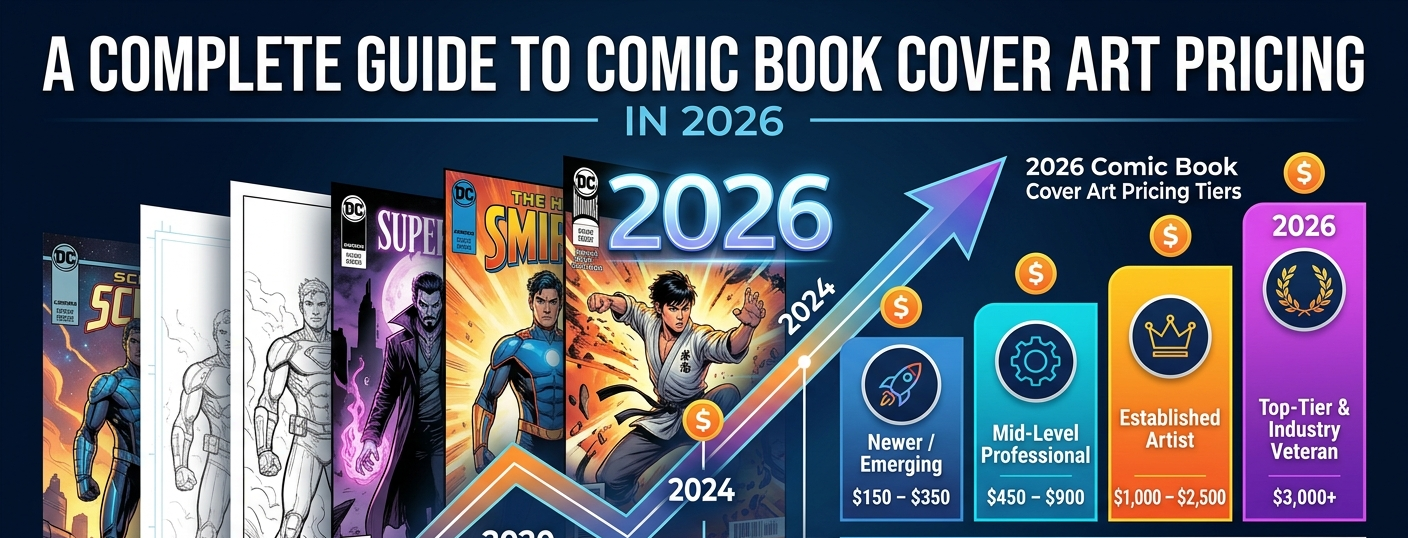
Let’s start with numbers, because that’s what you came for. In the US market right now, comic book cover art pricing 2026 tends to sort itself into a handful of tiers. These are full-color, print-ready covers — the real deal, not a quick sketch.
- Newer / emerging artists: about $150 – $400 a cover
- Mid-level pros: about $450 – $900
- Established artists with a name: about $1,000 – $2,500
- Top-tier and industry veterans: $3,000 – $10,000+
Now flip it around. If you’re the artist trying to figure out how much to charge for comic book covers, those same brackets are your map. Price yourself on experience, speed, and — this part gets forgotten — what your name adds to the book’s sales, not just the hours at the desk.
And yeah, that spread looks enormous. It should. A talented newcomer building a portfolio and a veteran with a fifteen-year track record are technically doing the same task. They are absolutely not selling the same thing.
Why Two Quotes Can Be $2,000 Apart
Once you see the levers, the pricing stops feeling like a coin flip.
Reputation. This is the heavyweight factor in comic book cover artist rates. A known name doesn’t just make pretty art — it moves copies. Buyers pay for that pull, and they’re right to.
Detail. One clean character on a flat background is a different animal than a rain-soaked rooftop brawl with three figures, neon reflections, and a skyline behind them. Every extra element is another hour, another decision, another dollar.
Rights. A cover for your self-published one-shot is priced one way. A cover licensed for merch, reprints, and a marketing push is priced another. Wider usage, bigger number. Simple as that.
Deadline. Want it in four days instead of four weeks? Rush work usually tacks on 25% to 50%. Artists have lives; you’re paying to jump the line.
Revisions. Most quotes bake in one or two rounds. Ask for a tenth and the comic book cover art commission price climbs fast. That’s the whole reason a decent contract nails down revision limits before anyone picks up a stylus.
Full Covers vs. Commissions — Not the Same Thing
People smash these two together and then wonder why the prices don’t match.
A custom comic book cover cost on a published project assumes commercial use, a polished print file, and real collaboration on the concept. That’s the pipeline our team runs on every comic book illustration project — brief, sketch, feedback, finish.
A personal comic book cover art commission price — a fan piece, a birthday gift, something for your wall — usually runs lower because it’s private, non-commercial. In 2026, typical comic book art commission rates land around here:
- Sketch / line-art cover: $100 – $300
- Full-color personal cover: $300 – $1,200
- Detailed commercial commission: $800 – $2,500+
One thing worth saying out loud: if your cover leans on a single strong hero figure, a big chunk of the cost lives in the character design, not the background. Nail the character and the composition basically builds itself.
The Page-Rate Breakdown
Publishers often prefer to think in comic book page rates 2026 instead of one flat cover fee — and honestly, it’s a smart way to see where the money actually goes, because a cover is really four jobs wearing one trench coat. Rough US splits for 2026:
- Penciling: $80 – $250
- Inking: $60 – $180
- Coloring: $90 – $250
- Lettering / logo: $25 – $100
Hire one artist for the whole thing and you’re paying a bundle. Split it across a studio and understanding penciler and colorist rates on their own tells you exactly what each stage is worth. Neither route is automatically cheaper — it comes down to whether you’re buying speed, consistency, or specialization.
Variant Covers: Where the Budget Gets Spicy
Variants get their own line, always. A variant cover illustration cost runs higher than a standard cover for one blunt reason — variants exist to be collected. They live or die on a bold hook, and publishers will often bring in a bigger name specifically to make that variant fly off the rack.
For 2026, plan on $500 to $3,000+ per variant, and plenty more once a marquee artist is attached. Doing a stack of them for a launch? Ask about package pricing early. Most studios — ours included — quote a batch far kinder than a pile of one-offs.
Budgeting When You’re Indie
If you’re self-publishing, those top-tier numbers probably made you flinch. Relax. A smart indie comic book artist budget doesn’t need to be huge — it needs to be aimed. A few moves that actually work:
- Buy one killer cover, not three okay ones. Your cover is the handshake. Spend where it counts.
- Bundle it. Commissioning your book cover design alongside interior art usually drops the per-piece cost.
- Write a tight brief. Revision creep is the quiet budget-killer. Say what you want the first time.
- Match tier to goal. A hungry mid-level artist can hand you knockout work without top-shelf pricing.
The point was never to spend the least. It’s to spend so the cover pays itself back in shelf appeal and sales.
How to Actually Get a Real Quote
Vague ask, vague price. Want a straight number instead of a shrug? Hand over these five things when you reach out:
- Final size and format — print, digital, or both
- Detail level and how many characters
- Where and how you’ll use it (licensing scope)
- Your real deadline
- Whether you need variants or a matching series look
The sharper your brief, the fairer your quote. You can eyeball our range and style on the portfolio page, and when you want a number that isn’t a guess, just tell us about the project.
Final Word
Comic book cover art pricing 2026 stops being a riddle the second you know the tiers and the levers behind them. Debuting one indie book or lining up a full slate of variants — either way, the smart play is the same: match your goal to the right artist tier and say what you mean from the first email. A great cover isn’t a cost you swallow. It’s the first thing a reader falls for before they’ve read a single panel.
Frequently Asked Questions
How much does a comic book cover cost in 2026?
In the US, newer artists charge $150–$400, pros run $450–$2,500, and top names hit $3,000+, based on detail, deadline, and usage rights.
Why are variant covers pricier?
Variants are made to be collected and often use bigger names, so a variant cover illustration cost usually lands at $500–$3,000+, above a standard cover.
Flat rate or page rates — which is better?
Flat rates fit single covers; page rates help when splitting pencils, inks, and colors. Both are normal in comic book cover art pricing 2026.
What pushes a commission price up?
Extra detail, more characters, rush deadlines, wide licensing, and heavy revisions all raise the comic book cover art commission price past the base quote.
Can I afford a good cover as an indie?
Yes. A smart indie comic book artist budget spends on one hero cover, bundles work, and hires a solid mid-level artist for quality without top-tier pricing.