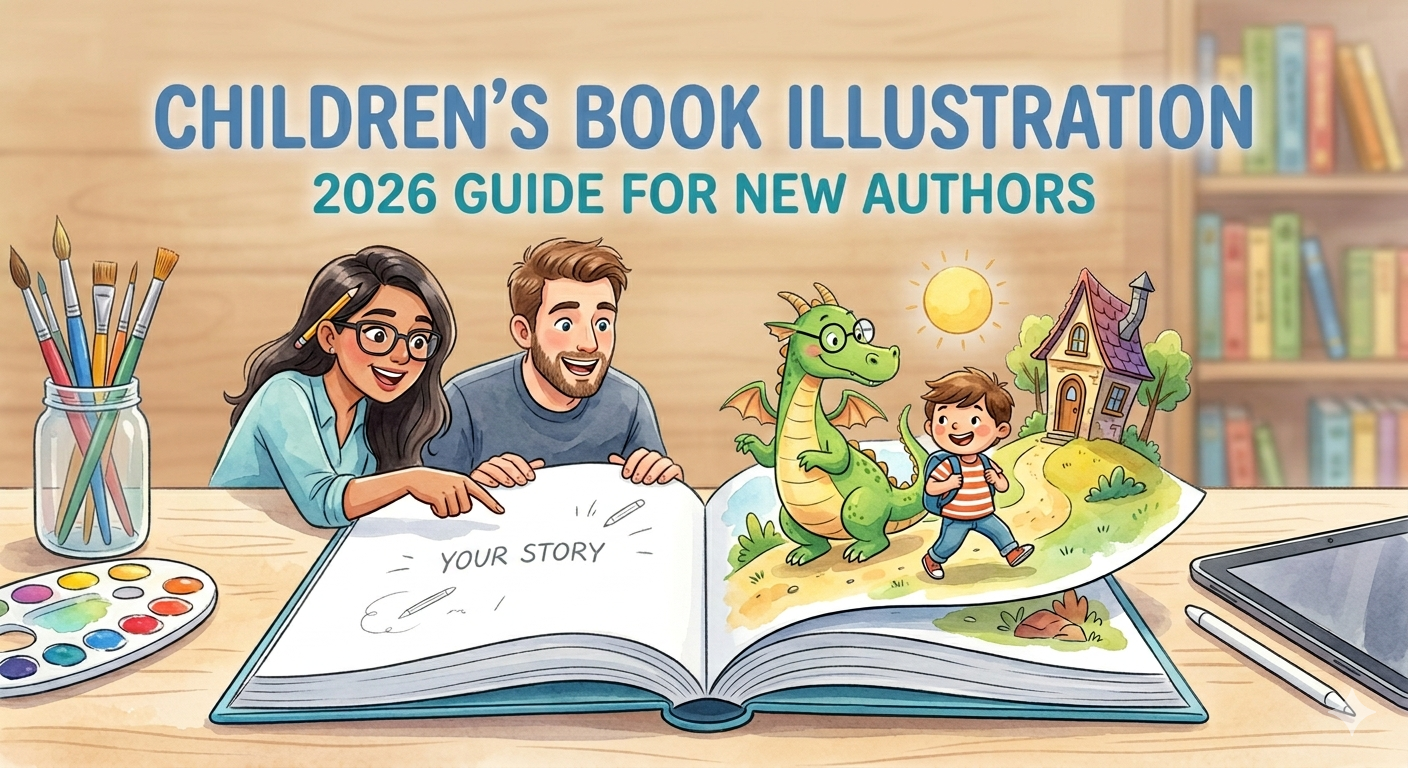
Children’s book illustration is what makes a kid stop flipping pages and just stare.
Not the words. The art.
Before a child has any idea what “narrative arc” means, they are already reacting to what they see — a crooked little house on a hill, a dragon with kind eyes, a child who looks exactly as scared as they feel sometimes. That reaction is not accidental. It is the result of a specific set of decisions that authors make (or fail to make) before their book ever goes to print.
If you have written a children’s story and you are trying to figure out what comes next — this is the guide I wish existed when I started learning this space. No fluff, no obvious filler. Just what you actually need to know about children’s book illustration in 2026, whether you are publishing in the USA, in Pakistan, or anywhere else on earth.
What Children’s Book Illustration Actually Is
Children’s book illustration is every image in the book. The cover. The full-page spreads. The small character moment tucked into the corner of a page. The background that tells you it is winter before the text says a word.
What it is not is decoration.
This is the mistake new authors make most often. They think of illustration as a finishing touch — like a coat of paint on something already built. In reality, for most picture books, the illustrations are carrying more of the story than the words are. In a board book for toddlers, the images might be doing 80% of the emotional and narrative work. The text is almost secondary.
That completely changes how you should think about hiring, budgeting, and briefing your illustrator. You are not commissioning art to hang alongside your story. You are hiring a co-author who tells the story in a different language.
Children’s Book Illustration Styles: What Are Your Actual Options?
Walk into any children’s section of a bookstore — in New York or Karachi — and you will see maybe six or seven distinct visual languages on those shelves. Each one signals something specific to readers before they read a single word.
Here is an honest breakdown of the children’s book illustration styles that matter in 2026:
Watercolor
This is the grandparent of children’s book art styles, and it is still alive for good reason. Soft edges, color bleeding into color, textures that feel organic rather than constructed. Watercolor communicates warmth instinctively. It says: this story is gentle, safe, emotionally honest.
For bedtime books, animal stories, books about feelings — watercolor almost always fits. It also prints beautifully for Amazon KDP full-color runs. If you are targeting children aged 2–6 and your story has any tenderness in it, this is worth serious consideration.
Drawphics’ water coloring illustration service handles exactly this kind of work — expressive, hand-touched art made specifically for children’s publishing.
Digital Illustration
Most professional children’s book illustration in 2026 is done digitally. Not because it is aesthetically superior to traditional art — it is not, necessarily — but because it is practical in a way that print-on-demand publishing demands.
Digital illustration means: unlimited revision flexibility, perfect file specifications for KDP, colors that stay consistent across print runs, no scanning artifacts, no color shift from original to printed page. For self-publishing authors especially, these practical advantages are significant.
And here is the thing people miss: skilled digital illustrators can make their work look like watercolor, or ink, or gouache, or anything else. The medium is digital; the style is whatever the story needs.
Drawphics’ digital concept art service covers this whole spectrum — from clean flat graphic styles to fully painterly illustration.
Hand-Drawn Illustration
There is a specific readership — and it is a loyal one — that responds to the marks left by an actual hand holding an actual pen. The slight wobble in a line. The pressure variation in crosshatching. The texture that comes from paper grain catching ink differently in different places.
Hand-drawn children’s book illustration tends to shine in quirky, funny stories and in books that want an older, slightly nostalgic feel. Think the ink-heavy illustrations in classic Roald Dahl books. That texture is impossible to fake convincingly with digital tools. Readers feel it even when they cannot name it.
The tradeoff: hand-drawn art typically takes longer to produce and requires more careful post-production for print-ready files.
Flat / Graphic Style
Bold shapes. Deliberate color palettes. Clean outlines. Very little shadow or texture. This is the style you see in educational books, concept books for toddlers, and activity books.
It works because it reads at very small sizes — which matters enormously on an Amazon product page where your cover thumbnail might be 200 pixels wide. It also reproduces cleanly at any print scale, making it one of the most forgiving styles for first-time self-publishers.
Painterly / Fantasy Illustration
For chapter books with interior art, middle-grade illustrated stories, and any picture book with a richly built fantasy world — this is the style that creates depth, drama, and genuine visual investment.
Cinematic lighting, detailed backgrounds, character artwork that has actual emotional weight. This style takes longer to produce and costs more, but for the right story, nothing else will do.
How to Illustrate a Children’s Book: The Real Process
Most online guides describe how to illustrate a children’s book in a way that makes it sound cleaner than it is. Here is the actual process — including the parts that trip up first-time authors.
Lock the Manuscript First. Actually Lock It.
This is non-negotiable. Every illustration decision — character design, scene composition, color palette, the number of spreads — flows directly from the text. If your story is still changing, you cannot make any of these decisions reliably.
I have heard from authors who started illustration on a draft that was “almost final.” They ended up paying for revisions because a character changed, a scene was cut, or a new subplot required new environments. Finish the story first. Then illustrate.
Figure Out Format and Page Count
Here are the standard formats:
- Board books — 10–14 pages, ages 0–3
- Picture books — 24–40 pages, ages 3–8
- Early illustrated chapter books — 48–80+ pages, ages 6–10
A standard 32-page picture book typically needs around 14–17 full-page or spread illustrations, plus the cover. That number directly determines your total illustration cost. Get this locked before you start getting quotes.
Build the Character Reference Sheet First
Before any full-page illustration gets started, you need a completed children’s book character design — a reference sheet showing your main characters from multiple angles, with multiple facial expressions, and any key costume or accessory details.
This sheet is the illustrator’s bible. Without it, your protagonist might look slightly different on page 6 versus page 22, and children will notice. Adults notice too. Character consistency is a foundational quality signal that separates professional books from amateur ones.
Create a Storyboard
A storyboard is a rough sketch — often just boxes with stick figures — showing what scene goes on which page and whether it is a full-page illustration, a half-page, or a two-page spread.
Doing this before any final illustration begins saves real money. It costs almost nothing to change a composition at the stick-figure stage. It costs a lot to change it after final color is applied.
Illustrate in Rounds — Not All at Once
Professional illustrators work in review rounds: rough sketch, then tight sketch, then final color. Each round requires author approval before the next begins.
The instinct for new authors is to let everything run simultaneously and review it all at the end. Resist this. If a compositional error runs through 15 pages before you catch it, your revision costs multiply by 15.
Prepare Print-Ready Files for KDP
For Amazon KDP children’s book illustration, the technical requirements are specific:
- Minimum 300 DPI resolution for interior images
- Full bleed of 0.125 inches on all sides for any art that reaches the page edge
- Important visual elements kept at least 0.25 inches from trim edges
- Color profiles appropriate to your output format
An illustrator who delivers beautiful art at 72 DPI (screen resolution) is handing you files you cannot print professionally. Ask about this before hiring anyone.
The Illustrators Worth Studying
If you want to understand what beautiful children’s book illustrations look like at the highest level, these are the people worth knowing.
Maurice Sendak illustrated Where the Wild Things Are with dense, crosshatched linework that felt wild and unsafe in exactly the right way. His pictures grew to fill full bleeds as Max’s adventure escalated, then shrank back to small framed images as he returned home. The illustration pacing is the emotional arc of the book.
Eric Carle invented his own technique — tissue paper collaged and painted over, then cut into shapes. The result is a textured handmade warmth that reproduces in mass printing without losing what makes it feel human. His work is also a masterclass in composition for very young readers: big, simple, unambiguous.
Beatrix Potter was a naturalist before she was an illustrator, and her watercolor precision reflects that. She drew animals with scientific accuracy and gave them human emotion through posture and expression rather than exaggeration. Her books are still in print over a century later. That is the durability of a truly consistent visual voice.
Quentin Blake drew with a scratchy urgency that felt like the picture was racing to keep up with the story. His Roald Dahl collaborations created a visual language so specific that those books feel genuinely incomplete without his art.
What all of them share: a distinctive, immediately recognizable visual style that belonged to their stories specifically. That is the standard to hold your own book’s illustrations to.
How to Hire Children’s Book Illustrators Without Getting Burned
Hiring children’s book illustrators for hire is where most first-time authors make their most expensive mistakes. Here is how to avoid the common ones.
Where to Look
- Dedicated illustration studios — studios like Drawphics offer full-service children’s book illustration packages with defined scope, revision rounds, and professional file delivery. For first-time authors without industry connections, this is the lowest-risk option.
- Freelance platforms — quality varies enormously; vetting takes real time and experience
- Referrals from other self-published authors — often the best leads, because the recommender has already done the vetting
- Instagram and Behance — illustrators post their best work there; useful for finding a style, less useful for evaluating professionalism
What to Actually Look at in a Portfolio
One beautiful illustration is not a portfolio. When evaluating children’s book illustration portfolios, look for:
- Complete book examples — multiple pages from a single project, not just standalone images
- Consistent character design across pages — same character, different scenes, looks like the same character
- Range of facial expressions and emotional moments
- Backgrounds that feel designed, not just filled in
- Evidence of print-quality file delivery
If you only see one or two stunning standalone images and nothing that looks like a full book, ask for complete examples before proceeding.
Questions That Actually Matter Before You Hire
- Have you completed full picture books from cover to final file? Can I see examples?
- How many revision rounds are included, and what counts as a revision?
- What file formats and resolutions do you deliver?
- Have you worked with Amazon KDP specifications before?
- What is your realistic timeline for a 32-page book?
You can also review the Drawphics FAQ page for detailed answers on how their illustration process works.
Children’s Book Illustration Pricing: Real Numbers for 2026
Children’s book illustration pricing is one of the most searched and least honestly answered questions in self-publishing. Here is a straightforward breakdown.
| What You Are Paying For | Realistic Range (USD) |
| Character design / reference sheet | $150 – $600 |
| Single full-page illustration | $100 – $800 |
| Complete 32-page picture book | $1,500 – $8,000+ |
| Book cover illustration only | $200 – $1,200 |
| KDP file preparation and export | Usually included in packages |
What pushes prices up:
- More complex illustration styles (painterly costs more than flat/graphic)
- Higher page counts
- Larger character casts requiring more character design upfront
- Tight turnaround timelines
- Unlimited revision policies
For context: studios in Pakistan working at international quality standards — like Drawphics — frequently offer significantly better value than equivalent-quality work from US-based illustrators. This is a practical reason why authors in the USA increasingly outsource children’s book illustration to Pakistani studios, and why Pakistani authors publishing on Amazon KDP can compete at professional quality without the budget that traditionally required.
Explore the full range of children’s book illustration services at Drawphics.
Amazon KDP and Children’s Book Illustration: What the Platform Actually Requires
If you are self-publishing on Amazon — which is most new authors in 2026 — your KDP children’s book illustration needs to meet specific technical requirements that exist separately from general print standards.
Here is what matters:
- Interior image resolution: 300 DPI minimum. Not suggested. Required.
- Full bleed: If your art extends to the edge of the page, add 0.125 inches of bleed on all sides
- Safe zone: Keep text and important visual elements 0.25 inches from trim edges
- Color: RGB works for both eBook and print (KDP converts for print); do not deliver CMYK unless your printer specifies it
An illustrator unfamiliar with KDP will sometimes deliver gorgeous artwork in the wrong resolution or without bleed. This results in blurry prints, white borders, or files rejected by the platform entirely.
Drawphics’ KDP children’s book service is built specifically for Amazon publishing. Every file delivered is KDP-compliant without the author needing to chase technical specifications.
Different Children’s Book Illustration Styles: A Side-by-Side Comparison
| Style | Best Story Fit | Target Age | Production Speed |
| Watercolor | Gentle, emotional, nature-based | 2–6 | Medium |
| Digital painterly | Fantasy, adventure, rich world-building | 4–10 | Medium-fast |
| Flat / graphic | Concept books, educational, activity | 1–6 | Fast |
| Hand-drawn ink | Humor, quirky, classic feel | 4–9 | Slower |
| Collage / mixed media | Experimental, texture-focused | 2–7 | Slower |
Style choice should always start with story tone, not with what looks impressive in a portfolio. A quiet bedtime story illustrated in a dramatic, high-contrast painterly style is a mismatch that readers feel even when they cannot articulate why.
Visual Storytelling for Children: The Principles That Separate Good Illustration from Great
Visual storytelling for children follows rules that are different from illustration in any other context. Here are the ones that actually matter.
Your Character Has to Look Like Themselves Every Time
Character consistency across a picture book is not a small thing. If your protagonist looks slightly different on page 4 versus page 28 — different proportions, different face shape, different color — a child will catch it. They may not say anything about it, but it will subtly undermine their trust in the book.
This is why character development for children’s books always comes before full-page illustration. Not as a preliminary step. As the foundation.
Every Spread Should Make You Want to Turn the Page
The turn of the page is the core unit of pacing in a picture book. Each book spread illustration should leave something unresolved — an expression, a moment, a question — that makes the reader want to know what comes next.
This is not just a text problem. The illustration carries this tension. A skilled children’s book illustrator composes each spread with the page turn in mind.
Not Every Page Needs a Full-Page Illustration
Full-page illustration gets attention because it fills the eye completely. But used on every single spread, it creates a visual monotony. Varying image size — full spread, half page, small vignette — gives the book a reading rhythm. The variation also lets certain full-page moments land harder by contrast.
Clarity Over Complexity
Children’s book art that works is art that communicates immediately. Big eyes. Clear expressions. High color contrast. Strong focal points. The impulse to add detail and complexity — to show how skilled the illustrator is — often works against the child reader who needs to process the image quickly and move into the story.
Child-friendly art style is not a constraint. It is a discipline.
Custom Children’s Book Illustrations: Why Generic Art Loses
Custom children’s book illustrations built specifically for your story will always outperform stock characters or recycled designs. This is not a preference — it is a competitive reality.
On Amazon, two picture books in the same niche are both thumbnails on a search results page. The one with an original, story-specific cover that feels like it was built for that exact story reads differently from the one with a character who looks borrowed from somewhere else. Children sense this. Parents sense it more.
Custom illustration also means your protagonist is yours — not shared with eleven other books on the platform, not recognizable as “the default illustrated child character.” The specificity of custom art is a publishing advantage.
For custom children’s book illustrations built from your story brief and owned entirely by you, explore Drawphics’ custom children’s book illustration service.
The Children’s Book Cover Illustration: Your Single Most Important Asset
The children’s book cover illustration gets judged in about 1.5 seconds. On a screen, as a thumbnail. Before anyone reads the title, before they look at the author name, before they consider the price.
A great cover illustration does several things simultaneously:
- Communicates genre and tone before any text is read
- Features a character in a compelling moment, not a static pose
- Uses color that reads clearly at thumbnail size
- Creates a visual personality specific to that book
Test every cover concept at thumbnail size before approving it. What looks striking at full scale sometimes disappears into noise at 200 pixels wide — which is exactly how most buyers will first encounter your book.
The cover is also where the ROI on illustration investment is highest. Interior art matters, but an author who underinvests in the cover to save budget has made a backwards decision. The cover is what creates the sale. The interior art is what creates the reader.
For professional book cover design and illustrated book covers, Drawphics handles both the illustration and the typography as a single cohesive package.
How Long Does It Take to Illustrate a Children’s Book?
Realistic timelines — not the optimistic estimates you might get from a rushed freelancer:
| Stage | Realistic Duration |
| Character design and approval | 1–2 weeks |
| Storyboard / layout | 1 week |
| Rough sketches, all pages | 2–4 weeks |
| Final color illustration | 4–8 weeks |
| Revisions and file delivery | 1–2 weeks |
| Full 32-page picture book | 8–16 weeks total |
If someone quotes you a full picture book in three weeks, ask detailed questions before you believe it. Quality illustration at professional standards takes time — and rushing it typically shows in the final product.
Build your publication timeline backwards from your intended launch date, and add a two-week buffer for unexpected delays. They happen more often than not.
Publishing Children’s Books in Pakistan: A Real Opportunity in 2026
Pakistani authors and illustrators are genuinely underrepresented in the global children’s book market — and that gap is closing fast.
Amazon KDP is fully accessible from Pakistan. An author in Lahore writing a bilingual Urdu-English picture book, a retelling of a Mughal-era folktale, or an original story about a child growing up in a Pakistani city has genuine access to international readers. The market does not care where you live. It cares whether the book is good.
Pakistani illustration studios working at international standards — like Drawphics — understand both what Western markets expect from children’s book art and what cultural specificity can make a book stand out. That combination matters.
For US authors, Pakistani studios also represent exceptional value. Work that might cost $5,000–$8,000 from a US-based illustrator can frequently be completed at equivalent or superior quality for significantly less — without sacrificing any production standard.
To see the work and understand the team, visit the Drawphics portfolio and the About Us page.
Should You Illustrate Your Own Children’s Book?
Short answer: only if you are already a working illustrator.
Longer answer: if you have a strong illustration background and a genuine visual style — yes, illustrating your own book can create a rare authorial unity between text and image. Some of the most beloved picture books were created by author-illustrators.
But if you are a writer who wants to learn illustration for your first book — that is a multi-year project, not a shortcut. The skills required to maintain character consistency across 30 pages, compose scenes with proper visual pacing, produce print-ready files at professional specifications, and develop a distinctive style take years of focused practice.
If you want to build those skills, start now. Draw every day. Study picture books analytically, not just as a reader. Learn Procreate or similar digital tools. Get honest feedback from working illustrators.
But also: do not let the desire to do everything yourself delay a book that readers are waiting for. Hire a professional for this book. Build your own skills in parallel.
What a Professional Children’s Book Illustration Service Should Include
When you engage professional children’s book illustration services, here is what the scope should cover:
- Creative consultation — understanding your story, target age, visual preferences, and publishing platform
- Character design with defined revision rounds before full illustration begins
- Page layout / storyboard development and approval
- Sequential illustration of all interior spreads
- Cover illustration (sometimes scoped separately)
- Print-ready file delivery in formats appropriate to KDP or your chosen printer
- Full IP transfer — you own every final file outright
A professional studio will also tell you things you might not want to hear: that your timeline is not realistic, that your budget does not match your scope, that a specific character design choice is going to create consistency problems across 30 pages. That kind of honest pushback is a feature, not a problem.
You can learn more about how the process works at Drawphics or review common questions on the FAQ page.
Putting It Together: What to Do Next
If you have a manuscript ready and you are trying to figure out where to start — here is the actual sequence:
- Lock the manuscript. No revisions after illustration begins.
- Define your target age group and how many pages the book needs.
- Choose your illustration style based on your story’s emotional tone.
- Budget realistically — the $200 illustration package will not produce a professional book.
- Find an illustrator or studio with a complete, proven picture book portfolio.
- Start with character design before anything else is drawn.
- Review every round before approving the next one.
- Confirm KDP-ready file delivery is included before you sign anything.
Children’s book illustration is not the finishing touch on your story. It is the other half of it. Treat it that way, and you will end up with a book that earns the reaction you wrote the story for — a child who stops flipping pages and just stares.
For children’s book illustration services covering the full pipeline — character design,custom illustrations, KDP-ready files, and book cover art — explore the full offering at Drawphics.
Frequently Asked Questions
Q1: What is children’s book illustration?
It’s the visual art in picture books that carries emotion, character, and story — often doing more narrative work than the words themselves.
Q2: How much does a children’s book illustrator cost?
A full 32-page picture book runs $1,500–$8,000+ depending on style, complexity, and illustrator experience level.
Q3: How do I hire a children’s book illustrator?
Check for full-book portfolio examples, confirm KDP-ready file delivery, clarify revision rounds, and use a trusted studio like Drawphics.
Q4: How many illustrations does a children’s book need?
A standard 32-page picture book needs roughly 14–17 interior illustrations plus a cover, depending on layout and format.
Q5: Can I publish an illustrated children’s book on Amazon KDP?
Yes. KDP supports full-color picture books. Files need 300 DPI minimum with proper bleed. Drawphics delivers KDP-compliant files directly.