Let me guess. You’ve decided your brand needs video, you’ve got a budget sitting there waiting to be spent, and now you’re stuck on whiteboard animation vs 2d with no clue which one is right. Welcome to the club. This is the exact spot where most marketing folks stall out.
Here’s the thing nobody tells you upfront: the two styles aren’t rivals fighting for the crown. They’re more like a screwdriver and a hammer. Grab the wrong one and the job still gets harder than it needs to be.
So I’m going to walk you through the whiteboard animation vs 2d call the way I’d explain it to a friend over coffee, not the way a slick sales deck would. Cost, engagement, conversions, the works. By the end you’ll actually know which one fits.
And if you’re already sold and just want to get moving, our animation services crew handles both. But stick around a minute. This’ll save you a headache.
Whiteboard Animation vs 2D: The Quick Answer
For the skimmers, here’s the gist.
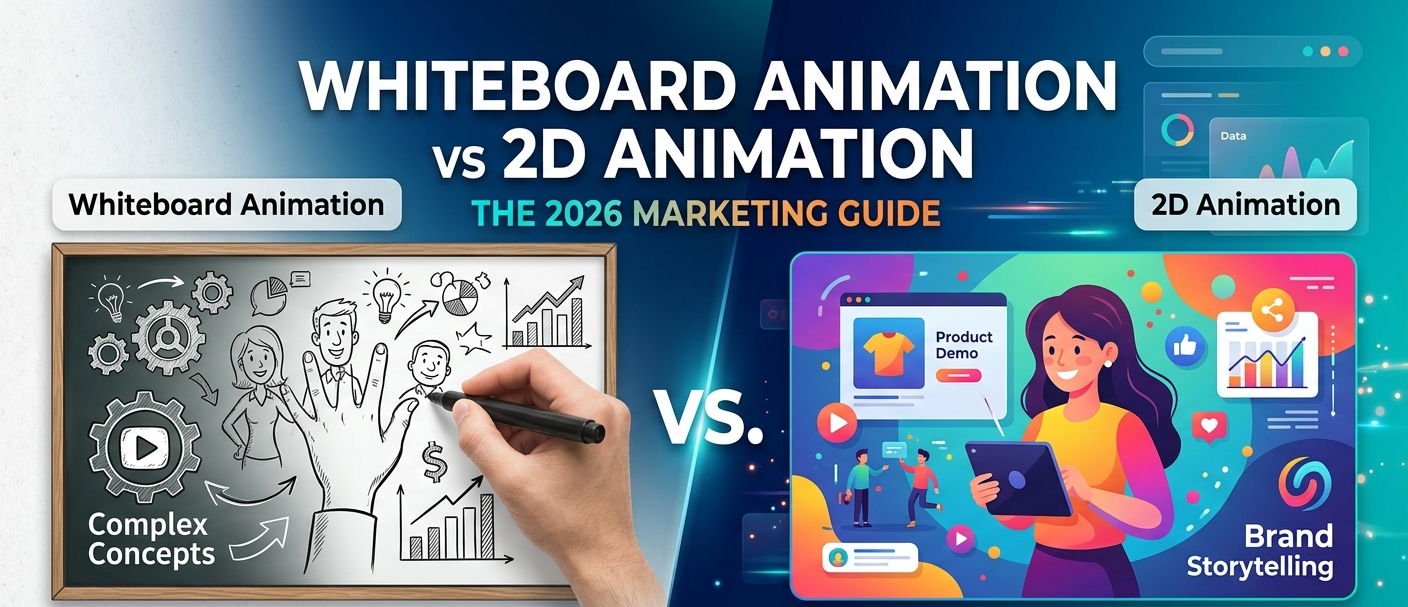
Whiteboard animation is the hand-drawn one. A marker sketches your story out on a plain white background while a voiceover talks you through it. Simple, human, a little rough around the edges in the best way. Perfect when you’re explaining something that makes people’s eyes glaze over.
2D animation is the bigger, flashier world. Flat colorful designs, branded characters, smooth motion, real polish. When someone says “explainer video” in 2026, this is usually the picture in their head.
Neither one wins outright. Whiteboard is your budget-friendly teacher. 2D is your premium brand builder. That’s the whole ballgame, and the rest of this is just figuring out which job you’re hiring for.
Why Whiteboard Animation Still Works
People keep predicting the death of whiteboard video. It keeps not dying. There’s a reason.
It’s the hand. Watching a drawing show up stroke by stroke does something weird and wonderful to your brain, you just keep watching to see what comes next. Marketers didn’t invent that, it’s baked into how attention works. A good scribble video can hold someone through a two-minute explanation that plain text would’ve killed in ten seconds.
And it feels honest. Hand-drawn animation doesn’t come off as a glossy ad shoved in your face. It reads more like a sharp friend doodling an idea on a napkin, and that lower-key vibe earns trust quick. Finance, healthcare, SaaS onboarding, anything with a learning curve, whiteboard just quietly gets the job done.
When whiteboard tends to be the right call:
- You’re walking people through a process or a “how it works”
- Money’s tight but the result still has to look professional
- Your topic is dense and you want it to feel friendly, not intimidating
- It’s internal training or teaching content
If any of that is your project, poke around our whiteboard animation work and you’ll see what I mean.
What 2D Animation Brings
Now the other corner of the 2d animation vs whiteboard animation matchup.
2D is where your brand gets to show off. Full color, custom character animation, kinetic type, motion graphics, camera moves, the kind of production value that makes people go “ooh.” When a video looks expensive, nine times out of ten it’s well-made 2D.
Flexibility is the real selling point though. Want a mascot popping up across your whole campaign? 2D. Want a product demo where the UI slides in all smooth? 2D. Want something polished enough to run as a paid ad without cringing? Yep, 2D again. It stretches from a plain little explainer video all the way to a full cinematic brand piece.
The catch is time and money, and we’ll get there. But when how your brand looks actually matters, and in 2026 it pretty much always does, 2D tends to edge ahead. Our 2D & 3D animation team does the whole range, from clean explainers to fully rigged characters.
Whiteboard vs 2D Animation for Marketing: Head to Head
Alright, let’s actually put whiteboard vs 2d animation for marketing side by side. This is where the real decision lives.
Engagement. Whiteboard hooks people through curiosity, the drawing keeps them leaning in. 2D hooks them through color and character. Both drive great audience engagement, but whiteboard holds educational viewers longer, while 2D crushes it on social feeds where the color stops a fast-scrolling thumb.
Conversions. This one trips people up. Whiteboard often posts a really solid conversion rate on explainer and landing pages because, well, clarity sells. 2D usually converts better on brand and product plays where emotion and polish do the heavy lifting. But here’s the honest truth, your offer and your script matter way more than the style. A clear message in either format smokes a muddy message in the prettier one.
Brand awareness. 2D takes this one, and it’s not really a contest. Recurring characters, steady color, a voice you recognize, that stuff makes 2D far stickier for brand awareness and long-haul recognition.
Shelf life. 2D ages better and chops up nicely into ads, social cuts, and thumbnails. Whiteboard is a bit more one-and-done, though a great whiteboard piece can happily sit on a product page for years.
Video Production Cost in 2026
Nobody loves the money chat, so I’ll keep it straight.
Whiteboard is usually the cheaper road. Fewer moving parts, simpler assets, quicker turnaround. If video production cost is the thing keeping you up at night and you just need something clean and professional, whiteboard’s your friend.
2D runs pricier, and the range is all over the place. A basic 2D explainer lands mid-tier. Start piling on custom character animation, detailed motion graphics, extra scenes, longer runtime, and the number climbs fast. You’re paying for design hours, rigging, and the polish that makes it look premium.
Simple way to think about it: whiteboard gives you great bang-for-buck on teaching and explaining. 2D gives you great bang-for-buck on branding and paid media, where that extra shine tends to pay itself back in performance. Neither’s a waste. They’re just built for different finish lines.
Real numbers hinge on length, complexity, and how many rounds of revisions you want, so don’t trust any blog’s ballpark, mine included. Contact us and we’ll scope an actual estimate for your project.
The ROI of Video Marketing
Debating style is fun. The ROI of video marketing is what keeps the budget from getting cut.
Video keeps its spot in the plan because it multitasks, it explains, it builds trust, and it nudges people to act, all at once. So the question was never “is video worth it.” It’s “which format returns more for my goal.”
For lead gen, onboarding, and “just explain the thing” content, whiteboard often delivers killer ROI because it’s cheaper to make and it genuinely clears the fog. Clarity shortens sales cycles. Shorter cycles are money. Simple math.
For brand campaigns, launches, and paid social, 2D usually returns more even with the bigger upfront tag, because it performs better as an ad, gets shared more, and drills your brand into people’s heads across every touchpoint. That compounding recognition is real ROI, even if it’s a pain to fit on a spreadsheet.
Honestly, the smartest video marketing strategy 2026 move is often “why not both.” Loads of brands run whiteboard in their help center and onboarding while pushing 2D on the homepage and in ad campaigns. Two tools, two jobs, one plan that actually holds together.
How To Choose For Your 2026 Plan
Decision time. Skip the coin toss, run through this instead.
Go whiteboard if your main job is to explain or teach, the budget’s lean, the topic’s complicated, or you want that trustworthy, no-pressure feel. It’s the steady pick for corporate video production built around clarity.
Go 2D if brand perception is on the line, you need character-driven storytelling, you’re making paid ads, or you want assets you can slice up across channels. It’s the move when you want the work to look like a real brand made it.
Do both if you’ve got an actual campaign with stages. Play each format to its strengths and let them cover each other’s blind spots.
Still on the fence? Totally normal, and it usually just means your goal isn’t nailed down yet. One quick chat about what you’re really trying to move, awareness, leads, or plain understanding, and the answer basically picks itself. We do this all day. Flip through our portfolio to see both styles on real projects, then reach out when you’re ready.
Final Word on Whiteboard Animation vs 2D
The whole whiteboard animation vs 2d thing comes down to fit, not which one’s “better.” Whiteboard is your clear, affordable teacher. 2D is your polished, flexible brand builder. One explains, one elevates, and the sharpest 2026 plans just know when to reach for which.
Lock in your goal first, match the style second, write a script that doesn’t put people to sleep, and your video will earn its keep. Want a partner who does both and won’t shove you toward the pricier option for no reason? Let’s talk.
FAQs
Which is cheaper, whiteboard animation or 2D?
Whiteboard is usually cheaper thanks to fewer assets and faster production, making it ideal for tight budgets that still need a professional result.
Is whiteboard animation still effective in 2026?
Yes. The hand-drawn reveal keeps viewers hooked and explains complex ideas clearly, so it stays a strong, trust-building choice for explainer content.
Which format converts better?
It depends on your goal. Whiteboard often wins on explainer pages, while 2D tends to convert better on brand and paid campaigns. Script quality matters most.
Can I use both whiteboard and 2D animation?
Absolutely. Many brands use whiteboard for onboarding and education while running 2D for ads and homepage videos, covering each format’s weak spots.
Which is better for brand awareness?
2D wins for brand awareness. Custom characters, color, and a consistent visual voice make it far more memorable and recognizable across channels.