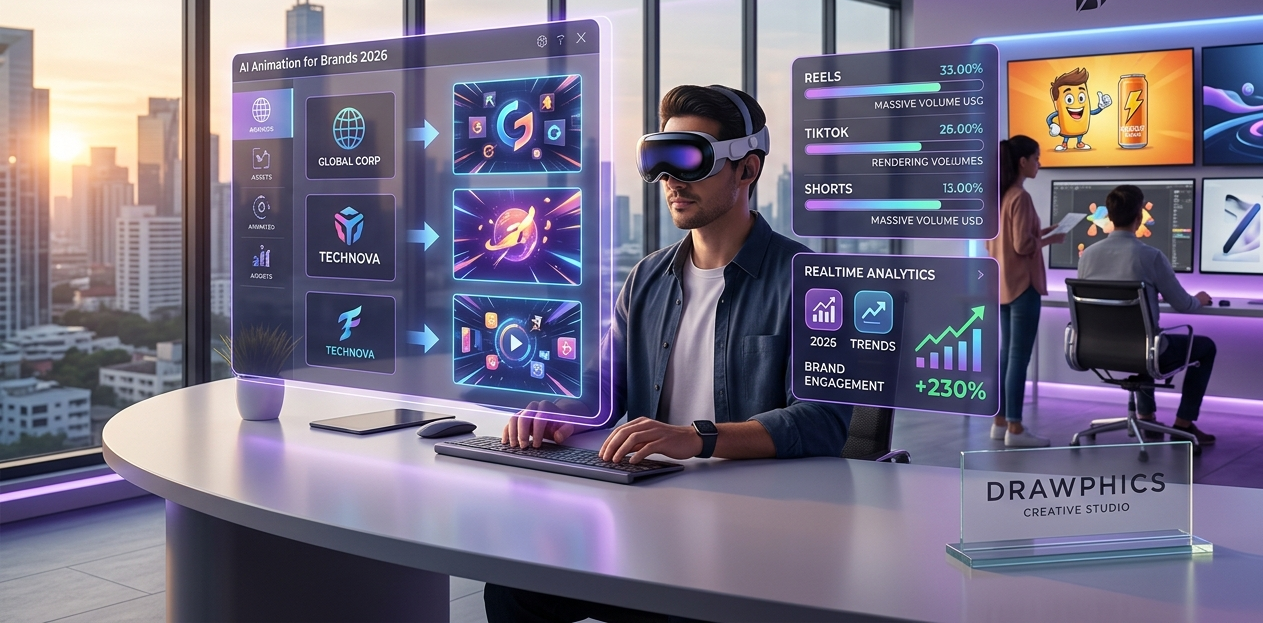
AI Animation for Brands 2026 is one of those topics where the hype and the reality finally caught up with each other. Two years ago, we’d sit in client calls and someone would ask, half-joking, “can’t AI just make this?” Everyone would laugh. Nobody’s laughing now. They’re asking seriously, and honestly? Sometimes the answer is yes.
But not always. And knowing the difference is worth real money this year.
We run Drawphics, an animation and design studio, and we’ve been using AI in our own AI animation pipeline long enough to have opinions. Some of them unpopular. So this isn’t a roundup written by someone who’s never opened a render queue — it’s what we’re actually seeing on projects for US brands right now, with the numbers to back it up.
AI Animation for Brands 2026: Why This Year Feels Different
Simple answer: the money moved.
US digital video ad spend is on track to pass $80 billion in 2026 — growing 11% year over year, which is nearly 20% faster than the ad market overall. And somewhere around 78% of marketing teams are now putting AI-generated video into at least one campaign per quarter. In early 2024 that number was closer to 30%. So no, this isn’t a fringe experiment anymore. Your competitors are doing it. Probably badly, but they’re doing it.
Then there’s the cost collapse, which still makes me do a double take. A finished minute of video that used to cost around $4,500 with a traditional crew? AI-assisted production, raw generation plus light human polish, now runs roughly $400–$800 depending on complexity, with pure AI generation alone often under $50 a minute. Production timelines went from about 13 days for a 60-second spot to under an hour, in some cases. That’s not an improvement. That’s a different industry.
When the math shifts that hard, everything downstream shifts with it, budgets, team structures, what “enough content” even means. Which brings us to the actual 2026 content creation trends worth paying attention to.
The 2026 Content Creation Trends That Actually Matter
Plenty of trend lists out there. Most of them pad the count to hit “10 trends” for the headline. Here are the five we’d bet on.
Short-Form Video Automation Is Eating Everything
If you only take one thing from this post, take this. Short-form video automation is the single biggest lever available to US brands right now.
The numbers are almost boring at this point: clips under 60 seconds pull about 2.5x more engagement per impression than anything else, and short-form now makes up roughly 67% of all AI-generated video. TikTok wants 21–34 seconds. Shorts likes 30–60. Reels eats up over 40% of all time spent on Instagram.
The problem was never “should we do short-form.” The problem is volume. Feeds are hungry. A brand that posted four videos a month in 2023 is expected to post four a week now, and no traditional workflow survives that. Automation does. Agencies running AI-assisted pipelines report shipping up to 11x more video per month with the same headcount. Same people. Eleven times the output. Let that one sit for a second.
Social-First Motion Graphics (Not TV Ads Chopped Into Squares)
There’s a specific look to a TV commercial that got cropped for Instagram, and audiences can smell it instantly. Social-first motion graphics fix that by starting on the phone screen — vertical from frame one, captions burned in (about 85% of AI-generated video ships with auto-captions now, because most Americans scroll on mute), and a hook inside the first two seconds or you’re done.
Here’s where we’ll be blunt though: pure AI output has a sameness to it. A flatness. It’s trained on averages, so it produces averages. The brands whose feeds actually look like something are pairing AI’s speed with real craft — proper 2D and 3D animation for the hero pieces, sharp social media content graphics for the daily grind, AI to multiply it all across formats.
Speed from the machine. Personality from a human. That combo is the whole game in 2026.
Text-to-Video Models for Marketing Went Mainstream
Text-to-video models for marketing now account for about 46% of AI video generation, which makes it the dominant creation method — ahead of everything else. Sora, Veo, Runway, Pika. The leaderboard reshuffles every couple of months, so I won’t pretend today’s ranking will hold by fall.
What I will say is how smart teams actually use them, because it’s not what the launch videos suggest. They’re not replacing production. They’re replacing the arguing-about-the-concept phase. A marketing lead types out three script directions on a Tuesday afternoon, generates rough cuts, shows stakeholders, kills two of them, and only then commissions the polished piece — say, a proper explainer video. Weeks of email ping-pong, gone. And the final deliverable lands better because everyone already agreed on the direction.
Brand Video Automation Stopped Being Just About Ads
Brand video automation used to mean cranking out ad variations. In 2026 it’s spread through the whole funnel, and the numbers on each stop are hard to ignore.
E-commerce product pages with AI video showcases are seeing engagement lifts around 156%. Email with video converts at roughly 9.1% versus 5.4% without — nearly double. Personalized video emails? About 4.1x higher click-through than a standard send. Even the unsexy internal stuff moved: AI avatar video for training and onboarding grew into a $5+ billion market mostly on its own.
The mental shift here: video isn’t a campaign asset anymore. It’s plumbing. It runs through everything, and AI content creation for brands is what makes running it everywhere affordable.
Digital Video Marketing Spend 2026 Favors Whoever Shows Up Prepared
One more spending note, because digital video marketing spend 2026 has a twist buried in it. Social video is growing around 13% this year and — for the first time ever — outpacing connected TV, driven mostly by AI personalization and creator-economy money. About 92% of marketers plan to hold or increase video budgets.
The twist? Small businesses with under 50 employees now make up nearly half of all AI video platform sign-ups. Read that again if you run a small US company. The production-budget moat that protected big brands for decades just drained. A ten-person outfit in Denver can now match the output volume of a national brand.
Can’t match their taste automatically, though. That still has to come from somewhere.
AI Video Marketing Strategies That Separate Winners From Noise
Owning Runway doesn’t make you good at this, the same way owning a Stratocaster doesn’t make you Hendrix. The AI video marketing strategies we’ve seen actually produce ROI share a few habits:
Feed the machine something original. AI scales whatever you give it. Give it generic stock vibes, get an infinite supply of generic. Give it distinctive character design and a real visual identity, and suddenly the scale works for you instead of diluting you.
Keep a human on the publish button. Around 72% of teams still require human review before anything goes live, and the data explains why — AI holds its own on quick social clips but falls apart on emotional brand storytelling. Machines for volume. People for the stuff that has to mean something.
Test dirt cheap, then spend on the winner. A/B testing video variations costs about 96% less with AI. Run five hooks, watch what sticks, then put actual production quality behind the one that earned it. Small US teams are beating bigger rivals with exactly this move.
Don’t pocket the savings — redeploy them. My favorite stat of the whole year: 82% of marketers who adopted AI video reallocated the freed-up budget into distribution and paid amplification. Cheaper production isn’t a reason to spend less. It’s a reason to spend where it compounds.
And match the format to the funnel while you’re at it. Short-form for reach, whiteboard animation and explainers for the consideration stage, personalized video to close. No single format does all three, whatever the sales page claims.
Best AI Video Generators for Businesses
Fine, the tool question — everyone asks. The best AI video generators for businesses in 2026, roughly by lane: Runway and Pika for creative generation, Synthesia and HeyGen for avatar-led corporate video, Sora and Veo for cinematic text-to-video, Pictory and InVideo for turning scripts and blogs into social clips.
But here’s what those comparison posts skip. The average enterprise now runs 3.2 AI video tools at once, and when marketers name their biggest adoption barrier, it isn’t price anymore — 43% say it’s in-house skill. The tools got easy. Making something worth watching didn’t.
That gap is where a creative partner earns its fee. Have a look through our portfolio and you’ll see what hand-crafted animation plus AI-accelerated production looks like on actual brand work — or read about how we approach it.
So Where Does That Leave You?
Honest close: AI Animation for Brands 2026 stopped being an advantage the day everyone got the same tools. What’s left is what was always there — a voice people recognize, a look they remember, and the discipline to show up in the feed every single week.
AI decides who can afford to play. Craft still decides who wins. Same as it ever was, just faster.
If you want an animation strategy that uses AI where it’s quick and humans where it counts, talk to us at Drawphics. And there’s more where this came from on our blog.
Frequently Asked Questions
1. What is AI animation for brands in 2026?
It means using AI video generation tools to produce branded motion content, social clips, ads, explainers, at high speed and low cost, with human animators refining the output for quality and consistency.
2. How much cheaper is AI video than traditional production?
Up to 91% cheaper. A finished minute that ran about $4,500 with a full crew now averages $400–$800 for AI-assisted production, or as low as $50 for pure AI generation. A 60-second video can go from brief to first draft in under an hour
3. What video format performs best for US brands right now?
Short-form under 60 seconds, by a wide margin — about 2.5x more engagement per impression than any other type. Vertical, captioned, social-first motion graphics rule TikTok, Reels, and Shorts.
4. Do brands still need human animators if AI can generate video?
Yes. Roughly 72% of teams require human review before publishing, and AI still struggles with emotional storytelling. The winning setup is human creative direction plus AI production speed.
5. How should a small business start with AI video marketing?
Pick one channel, nail down a visual style, use text-to-video tools for cheap drafts and testing, then invest in professionally produced flagship pieces once you know which concepts perform.
Published by Drawphics — a US-serving creative studio for animation, illustration, and graphic design.