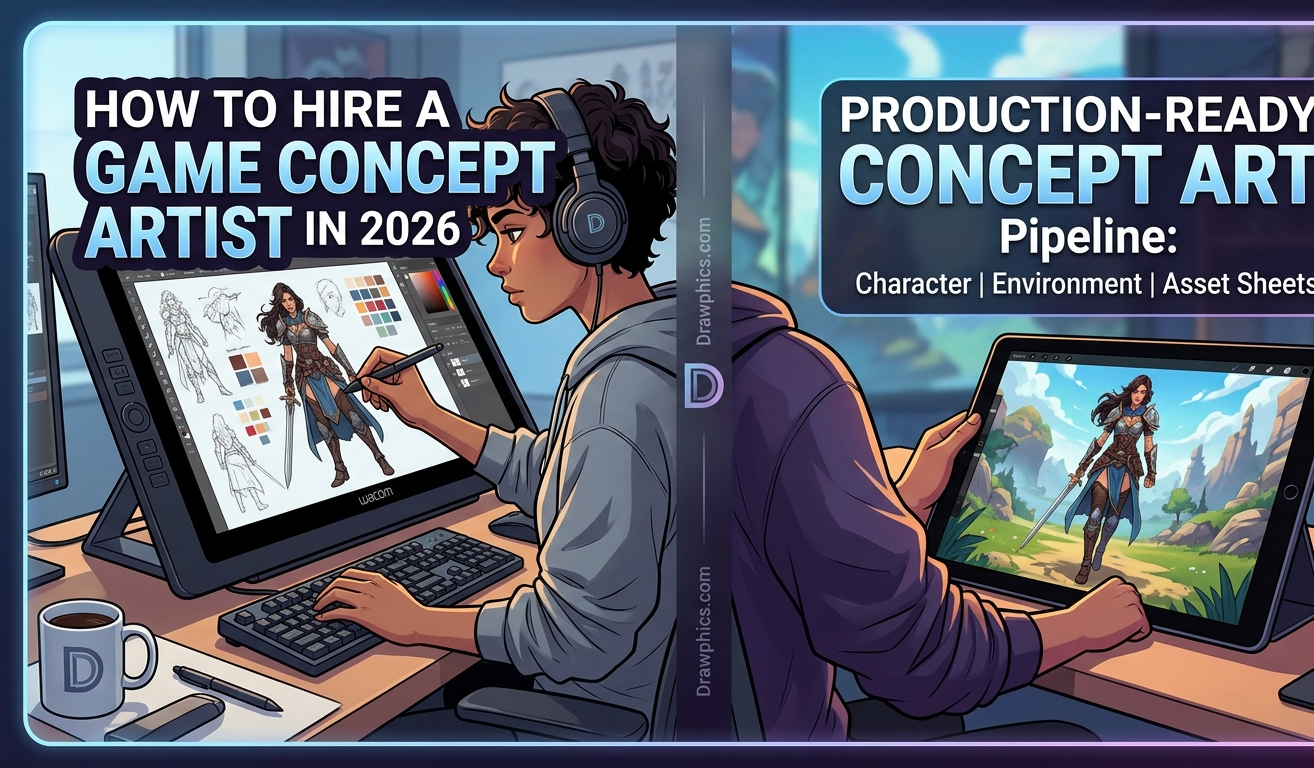
You decided to hire a game concept artist, and somewhere around the twelfth ArtStation tab you stopped knowing what you were even looking at. Been there.
Here’s the part nobody says out loud: concept art is the cheapest insurance your game will ever buy. A two-week visual exploration that runs a few thousand dollars can save you from half a year of building the wrong thing in 3D. That’s the whole pitch. You’re not paying for pretty pictures — you’re paying for decisions made before they get expensive.
So this is the no-fluff version. When you hire a game concept artist in 2026, here’s what they actually do, when to bring them in, what it costs in the US, how to read a portfolio without getting fooled, and the quiet mistakes that drain budgets. Let’s get into it.
What a Game Concept Artist Actually Does (and What They Don’t)
A concept artist figures out what your game looks like before anyone commits to building it. The hero. The worlds. The props. The mood of a rainy alley at 2am that the rest of the team can’t quite describe but absolutely knows when they see it. Their job is to design the visual language so everyone downstream has something concrete to chase.
What they’re not: your 3D modeler, your animator, or your UI person. Those are separate jobs with separate skill sets. Yes, at small studios one person sometimes wears two hats — plenty of folks who can bring characters to life also model them later. But the actual work of concept art is direction and decisions, not final production assets. Keep that line clear in your head. It changes who you hire and how you brief them.
When Should You Hire a Game Concept Artist?
Earlier than you think. That’s the short answer.
The right moment is pre-production — when you’ve got a genre, a vibe, maybe a rough story, but nothing locked. You bring in concept art before the modelers start, before you pitch to a publisher, and definitely before you’ve sunk forty hours into a 3D character you’ll end up scrapping.
The other big signal is inconsistency. If your game already looks like three different games stitched together, that’s not a modeling problem. That’s a missing visual foundation, and it’s exactly what concept art exists to fix.
2D or 3D? Why You Might Hire a 2D Game Artist First
Quick myth-bust: almost all concept art is 2D, even when the final game is 3D. Painting in 2D is just faster and cheaper for exploring ideas. Nobody sculpts twelve versions of a character in ZBrush to pick one — you sketch twelve and pick one.
Where it splits is the handoff. If you’re building a 3D game, the concept feeds your modelers. If you’re making a 2D game — a platformer, a mobile title, a card game — you’ll often want to hire a 2D game artist who can carry the concept all the way through to finished sprites and game-ready assets. Plenty of teams literally search “hire 2D game artist” when what they really want is one person who handles both the concept and the final art — so be clear about which job you’re actually posting. Our 2D illustration team handles that full ride when a project calls for it.
The Concept Art Pipeline: What You’re Actually Paying For
When you hire a game concept artist, you’re buying a process, not a single drawing. A real concept art pipeline moves in stages, and understanding those stages is how you avoid paying for the wrong thing at the wrong time.
Here’s roughly how it runs.
Character Concept Design
Good character concept design almost never starts with a finished render. It starts with silhouettes — six to twelve rough black shapes, because if a character doesn’t read as a strong silhouette, no amount of detail will save it. From there: three directions get developed, you pick one, and the artist builds out a hero pose, then a turnaround (front, three-quarter, side, back), expression sheets, and a color guide with actual hex codes so the look stays consistent.
That last bit matters more than people expect. A character that looks great in one drawing and slightly off in the next is a sign the color and proportion rules were never nailed down. This is the bread and butter of character design, and it’s worth getting right early.
Environment Concept Art
Environment concept art works the same way but at world scale. The artist starts with a reference board, blocks out thumbnail compositions to test camera angles, then does a grayscale value study to lock the depth — foreground, midground, background — before a single color goes down. Color keys come next (dawn? storm? neon midnight?), then the detailed paintover, then a callout sheet so the 3D team knows which pieces are modular and reusable.
Skip the value study and you get a pretty painting that falls apart the second someone tries to build it in engine. Don’t skip the value study.
Asset Sheet Production
This is the unglamorous stage nobody posts on Instagram, and it’s also where production timelines live or die. Asset sheet production takes the locked concepts and turns them into organized, labeled reference — orthographic views, props grouped together, materials called out — so your modelers and animators aren’t guessing or pinging the artist twelve times a day. Clean asset sheets are basically a translation layer between “the art” and “the build.” When concepts move into animation and rigging, these sheets are what keep everyone aligned.
The Art Style Guide That Ties It All Together
Here’s the document that quietly does the heavy lifting: the art style guide. It’s what keeps ten artists drawing like one person. Line weight rules, the palette, proportion ratios, lighting logic, plus a do’s-and-don’ts page with example art showing what’s on-brand and what isn’t.
If the person you hire doesn’t deliver some version of an art style guide, ask for one. Seriously. It’s the difference between a cohesive game and a Frankenstein of mismatched styles that confuses players without them knowing why. You can see how this consistency plays out across finished work in our portfolio.
Where to Find Them: Freelance, In-House, or Game Art Outsourcing
Three roads, three sets of tradeoffs.
Freelancers (ArtStation, Upwork, X) are the cheapest entry point and the most variable. You’ll find genuinely brilliant artists and also a lot of noise, and you’re the one managing scope, deadlines, files, and the inevitable “wait, that’s not what I meant.” Great if you have the time and a sharp eye.
An in-house hire gives you a dedicated artist who lives in your world, but it’s expensive and only makes sense past a certain studio size. Most indie teams aren’t there yet.
A studio or game art outsourcing partner is the middle path a lot of teams land on: you get a team, an existing pipeline, and one point of contact instead of juggling five freelancers. Game art outsourcing trades a bit of hourly savings for consistency, reliability, and not having to art-direct strangers at midnight. If that’s the route you want, our digital concept art service is built exactly for it — and you can read more about how we work before reaching out.
How to Read a Portfolio Without Getting Fooled
A pretty portfolio is easy. A useful one tells you whether someone can actually do the job.
Green flags: turnarounds and value studies (proof they think structurally, not just decoratively), range across different styles, visible problem-solving, and callout or asset sheets — those last ones mean they understand production, not just rendering. If you want a sense of what strong, varied output looks like, our digital illustration breakdown covers the techniques behind it.
Red flags: nothing but polished “hero” pieces with zero process shown, wildly uneven quality (suggests heavy reference-borrowing), and an inability to work in any style but their own. Game art lives and dies on matching a defined style, so test for that.
Best move? Pay for a small test project. A few hundred dollars to see how someone handles a real brief, hits a deadline, and takes feedback will tell you more than any gallery.
What It Costs to Hire a Game Concept Artist in the USA (2026)
The honest answer to “what does it cost to hire game concept artist help in the US?” is the least satisfying one: it depends — on scope, polish, and who’s holding the pen. So, ballpark ranges, not quotes:
- Junior / overseas freelance: roughly $20–50/hr, or about $100–300 per character concept
- Mid-level US freelance: around $50–100/hr, or $300–800 for a polished character with a turnaround
- Senior / AAA-experienced: $100–200+/hr, often project-based
- Studio or outsourcing packages: usually quoted per project, commonly $2k–15k+ depending on how many characters, environments, and assets you need
A few cost levers worth knowing: hourly is flexible but harder to predict, fixed-fee is predictable but needs a tight brief, and milestone-based (pay per delivered stage) is the sweet spot for bigger jobs. If you want a feel for how creative pricing breaks down in general, we did a full teardown in our illustration cost guide.
How to Write a Brief That Gets You Good Work
The quality of what you get back is almost always the quality of what you sent in. A strong brief includes:
- Genre and tone in one line (“dark cozy farming sim,” “neon arcade shooter”)
- 3–5 reference images of the look you’re chasing
- What to avoid — just as important as what you want
- Deliverables, spelled out: how many concepts, what format, what resolution
- Timeline and milestones
- Who has final approval (one person, ideally)
Vague briefs are expensive. Every “hmm, not quite” round of revisions is time you’re paying for. Tighten the brief, save the budget.
Mistakes That Quietly Waste Your Money
- Hiring before you know your own game. Concept art clarifies a vision; it can’t invent one from nothing.
- Skipping the art style guide. This is where revision cycles go to die.
- Paying for “final” art when you needed exploration — or the reverse.
- No test project. You found out they’re a bad fit after the deposit. Ouch.
- Wrong specialist. Hiring a 3D-focused artist for a 2D sprite game (or vice versa) wastes everyone’s time.
So, Should You Hire a Game Concept Artist?
If you’re past the napkin-sketch stage and about to spend real money building, then yes — lock the look first, build second. It’s the single highest-leverage decision in early game art, and it’s a lot cheaper than discovering your visuals don’t work after the assets are already modeled.
When you’re ready to hire a game concept artist who’ll take you from rough idea to a clean, production-ready style, get in touch with us. Bring your references — we’ll handle the rest.
Frequently Asked Questions
Q: How much does it cost to hire a game concept artist?
AUS rates run roughly $50–150/hr, or $300–800 per character concept. Studio packages are project-based, often $2k–15k+ depending on scope and asset count.
Q: Do I need a concept artist if my game is 2D?
Yes. Even 2D games need a locked visual style first. You can hire a 2D game artist to carry concepts straight through to finished sprites and game-ready assets.
Q: What’s the difference between a concept artist and an illustrator?
A concept artist solves design problems and sets direction for production. An illustrator delivers one finished image. Concept art feeds the pipeline; illustration is the result.
Q: How long does game concept art take?
A single character concept takes a few days to a week. A full art style guide with characters and environments usually runs 2–6 weeks, depending on revisions.
Q: What should I send before hiring?
A short brief: genre, 3–5 reference images, what to avoid, deliverables, resolution, timeline, and who approves. The clearer the brief, the faster and cheaper the work.